
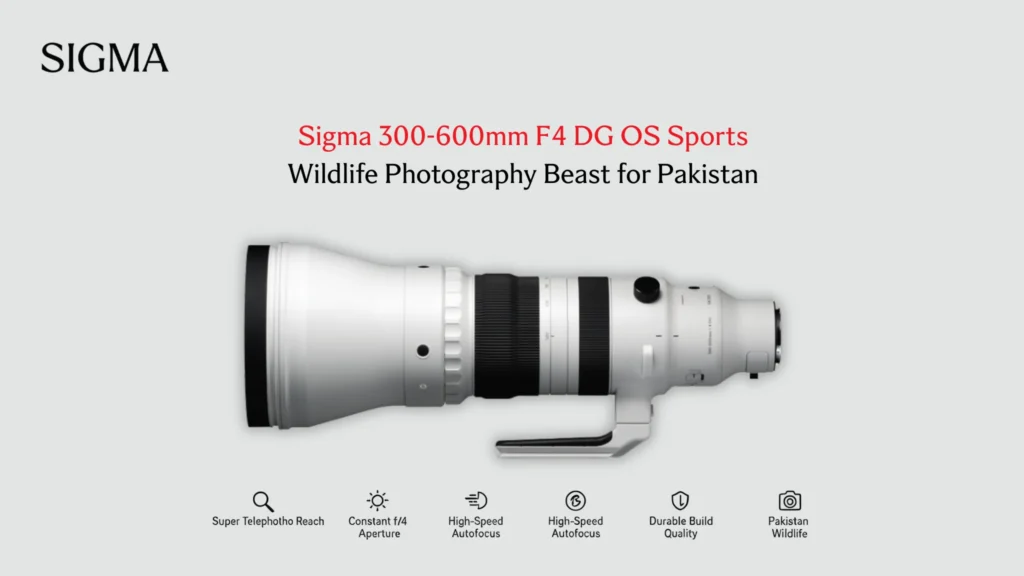
From the snow-covered peaks of the north to the wetlands of the south, Pakistan offers exceptional opportunities for wildlife photography. To grab a clear shot of a bird in flight or a shy animal on the move, you need more than just a lot of patience. You really need high-quality gear that won’t quit on you. That’s exactly where the SIGMA 300-600mm F4 DG OS | Sports comes in.
If you’re serious about finding the right lens, you know that how it actually feels out in the mud and wind matters a lot more than just the numbers on a box. Having fast autofocus, steady shots, and a lens that can take a few bumps is what makes all the difference when things get wild. Plus, it’s great to know your photos will look professional even when you’re zoomed in all the way.
In this guide, we’re looking at why this SIGMA lens is such a great pick for the tough outdoors here in Pakistan. We’ll talk about the zoom, the aperture, and how it actually handles in the real world so you can figure out if it’s the right fit for your camera bag.
Introduction to Wildlife Photography
Before choosing equipment, it is important to understand what is wildlife photography. It involves capturing animals in their natural habitats without disturbing their behaviour. Unlike studio photography, it requires patience, distance management, and rapid technical adjustments. In Pakistan, photographers encounter diverse species including migratory birds, snow leopards, ibex, and desert foxes.
Therefore, long focal lengths become essential. Because animals rarely allow close proximity, photographers depend on telephoto lenses to maintain safe distance while achieving frame-filling detail.
Additionally, lighting conditions vary dramatically. Early mornings and late evenings offer the best natural light, yet they also require lenses that perform well in low-light environments. Fast autofocus and stabilization systems further improve success rates when subjects move unpredictably.
Ultimately, success in wildlife photography combines knowledge of animal behavior with reliable gear. Choosing professional optics ensures sharp, well-exposed images even in fast, dynamic outdoor conditions.
Why Sigma 300-600mm F4 Best for Wildlife Photography
Selecting the best camera and lens for wildlife photography depends on reach, aperture strength, focusing speed, and build reliability. The SIGMA 300-600mm F4 DG OS | Sports delivers professional performance in all these areas.
First, its extended super-telephoto range allows photographers to frame distant subjects precisely. Second, the constant f/4 aperture ensures consistent brightness across the entire zoom range. Third, advanced autofocus motors provide fast subject tracking, especially useful for birds in flight.
Moreover, Optical Stabilization (OS) reduces camera shake when shooting handheld in outdoor terrain. Combined with Sports Line durability, this lens withstands dust, humidity, and temperature shifts commonly experienced across Pakistan’s regions.
For photographers focused on professional wildlife photography, this lens offers the performance and reliability needed for demanding field assignments.
300-600mm Super Telephoto Reach
The 300-600mm range provides exceptional subject reach without sacrificing image quality. At 600mm, distant birds or mountain species can fill the frame with sharp detail. This reach is particularly valuable for wildlife animal photography, where maintaining distance ensures safety and ethical practice.
Unlike shorter telephoto lenses, this range minimizes cropping, preserving resolution for large prints. Additionally, flexible zoom control allows photographers to reframe quickly as animals move. For Pakistan’s varied terrain, from wetlands to high-altitude valleys, this focal range delivers unmatched versatility and composition control.
Constant f/4 Aperture for Low Light
A constant f/4 aperture ensures stable exposure throughout the zoom range. This is crucial during early morning and sunset sessions when light levels drop quickly. Wider aperture performance allows faster shutter speeds, reducing motion blur.
Moreover, f/4 provides balanced depth of field, keeping subjects sharp while gently separating backgrounds. In dense forests or cloudy conditions, this brightness advantage improves reliability. For serious wildlife photography, maintaining consistent exposure across focal lengths enhances workflow efficiency and image quality in dynamic lighting environments.
High-Speed Autofocus for Birds and Action
Fast autofocus defines success in bird photography and action tracking. The SIGMA 300-600mm F4 features advanced focusing motors that lock onto moving subjects quickly and accurately.
When photographing birds in flight or running mammals, split-second response time prevents missed shots. Additionally, subject tracking modes on modern mirrorless cameras integrate smoothly with this lens. Accurate eye detection further improves keeper rates.
In fast-paced wildlife photography, autofocus precision directly affects professional output, especially when subjects move unpredictably across complex backgrounds.
Optical Stabilization (OS) Performance
Optical Stabilization compensates for camera shake during handheld shooting. At 600mm, even small movements can blur an image. Therefore, effective stabilization becomes essential.
The integrated OS system allows photographers to shoot at slightly slower shutter speeds while maintaining sharp results. This is helpful during extended field sessions where tripods are not always practical.
In mountainous or uneven terrain across Pakistan, stabilization improves flexibility and reduces fatigue. For demanding wildlife photography, OS performance ensures consistent clarity without relying entirely on support equipment.
Durable Sports Line Build Quality
The Sports Line design focuses on durability and professional endurance. Weather sealing protects internal components from dust, moisture, and temperature changes.
This rugged construction supports extended outdoor use in Pakistan’s diverse climates. From humid wetlands to dry desert regions, reliability matters. The lens barrel remains stable and balanced, even during prolonged shooting sessions.
For photographers seeking the best lens for wildlife photography, build quality ensures long-term investment value. Strong materials, precise engineering, and weather resistance combine to support demanding outdoor assignments confidently.
Sigma 300-600mm vs. 150-600mm: Which One for You?
Many photographers compare the 300-600mm F4 with the 150-600mm alternatives. Both offer strong telephoto reach, yet they serve slightly different needs.
The 150-600mm is versatile and more affordable, making it popular among enthusiasts. However, the 300-600mm F4 delivers a constant aperture advantage and superior optical consistency. For professionals working in challenging lighting conditions, this difference becomes significant.
Furthermore, image sharpness at wider apertures often favors the F4 Sports model. Photographers who frequently shoot in early morning light may benefit more from the brighter lens.
Ultimately, the choice depends on shooting style, budget, and performance expectations within wildlife photography.
Aperture and Low Light Advantage
The primary difference lies in aperture performance. A constant f/4 lens allows more light compared to variable aperture alternatives. This supports faster shutter speeds and improved low-light clarity.
In sunrise and sunset sessions, the brightness advantage helps maintain cleaner ISO settings. Additionally, depth of field control remains consistent throughout the zoom range.
For photographers frequently shooting in low-light outdoor environments, the 300-600mm F4 offers stronger exposure stability and creative control compared to slower aperture options.
Sharpness and Image Quality
Professional lenses emphasize consistent sharpness across focal lengths. The 300-600mm F4 maintains high clarity even at 600mm. Edge-to-edge sharpness improves crop flexibility.
Although the 150-600mm remains capable, the F4 Sports model delivers stronger performance at wide apertures. Reduced chromatic aberration and improved contrast enhance detail rendering.
For high-resolution cameras used in modern wildlife photography, optical precision becomes increasingly important. Photographers producing commercial prints or large publications benefit from maximum clarity and consistent results.
Who Should Choose the 300-600mm F4
The 300-600mm F4 suits professionals and serious enthusiasts focused on long-distance subjects. If your work involves birds in flight, mountain species, or safari-style shooting, this lens offers strong performance advantages.
Photographers prioritizing low-light performance and optical consistency will benefit most. It is particularly suitable for those who demand reliability under harsh outdoor conditions.
For dedicated wildlife photography professionals in Pakistan seeking premium results, this lens supports demanding assignments and long-term growth in specialized telephoto work.
| Feature | SIGMA 300-600mm F4 DG OS Sports | SIGMA 150-600mm F5-6.3 DG OS Sports |
| Focal Range | 300–600mm (Pro-level reach) | 150–600mm (More flexible range) |
| Maximum Aperture | Constant f/4 throughout zoom | Variable f/5–6.3 |
| Low-Light Performance | Excellent advantage for dawn & dusk wildlife | Moderate performance in dim conditions |
| Sharpness & Detail | Professional flagship-grade clarity | Very sharp for enthusiast and semi-pro use |
| Image Stabilization (OS) | Advanced stabilization for handheld shooting | Reliable stabilization for long-range capture |
| Weight & Portability | Heavier build for serious professionals | Lighter and easier to carry on trips |
| Best For | Wildlife professionals, safaris, sports photography | Wildlife enthusiasts, travel shooters, hobbyists |
Best Camera Settings for Wildlife Photography
Even the best equipment requires proper camera settings. In wildlife photography, exposure and focus adjustments directly affect clarity.
Fast-moving subjects demand high shutter speeds and responsive autofocus. Meanwhile, aperture selection controls depth and sharpness.
Balancing ISO with natural lighting conditions helps maintain image quality. Additionally, tracking modes and stabilization settings improve consistency. Understanding these technical fundamentals ensures you maximize the performance of professional lenses like the SIGMA 300-600mm F4.
Recommended Shutter Speed
Fast shutter speeds prevent motion blur when animals move quickly. For birds in flight, 1/1600s or faster is recommended. Running mammals often require at least 1/1000s.
Slower speeds may work for static subjects; however, wildlife rarely stays still. Therefore, maintaining a fast shutter ensures sharp details. In bright daylight, this setting is easy to maintain. During cloudy conditions, pairing fast shutter speed with appropriate ISO helps preserve clarity in wildlife photography.
Ideal Aperture for Sharp Results
Aperture selection balances depth of field and brightness. While f/4 provides strong subject isolation, stopping down slightly to f/5.6 may increase overall sharpness.
For single-subject portraits of animals, wider apertures enhance background blur. For group wildlife scenes, narrower apertures ensure multiple subjects remain sharp. Understanding how aperture affects detail helps photographers maintain control in different environmental scenarios within professional wildlife photography environments.
Autofocus and Tracking Modes
Continuous autofocus mode is essential for moving subjects. Modern mirrorless cameras offer animal eye detection and subject tracking features.
Activating continuous AF ensures the lens adjusts focus dynamically as animals move. Combined with high frame-rate burst shooting, this increases keeper rates. Accurate tracking proves especially helpful when photographing birds or fast mammals across unpredictable terrain and complex natural backgrounds.
ISO Settings for Outdoor Wildlife
ISO depends on lighting conditions and shutter speed requirements. In bright daylight, ISO 100–400 maintains clean images. During early morning sessions, ISO may increase to 800 or higher.
Modern sensors handle moderate ISO levels effectively, reducing noise concerns. Balancing ISO with aperture and shutter speed ensures proper exposure without sacrificing detail. In professional wildlife photography, clean exposure management improves overall image quality and post-processing flexibility.
How Far Can 600mm Shoot Wildlife?
A 600mm focal length offers impressive reach for distant subjects. However, effective shooting distance depends on subject size and environmental clarity. Atmospheric conditions, heat distortion, and subject movement all influence results.
In practical field scenarios, 600mm provides frame-filling detail from significant distances, making it ideal for bird and safari photography across Pakistan’s varied landscapes.
Bird Photography Distance
For small birds, 600mm allows photographers to maintain respectful distance while achieving detailed images. In open wetlands, subjects can be photographed clearly from dozens of meters away.
This distance prevents disturbance and supports ethical shooting practices. Additionally, longer focal lengths reduce cropping needs. In mountain regions or forest edges, 600mm reach becomes particularly valuable when birds remain perched high above ground level.
Mammal and Safari Scenarios
For larger mammals such as deer or ibex, 600mm enables safe shooting from extended distances. This is especially important in safari-style environments.
Maintaining space protects both photographer and subject. Furthermore, telephoto compression enhances background isolation, creating visually striking compositions. In open plains or elevated terrain, long focal reach ensures sharp, detailed results without compromising safety or ethics.
APS-C vs Full Frame Reach
On APS-C cameras, 600mm appears even longer due to crop factor, effectively increasing perceived reach. This can benefit photographers needing extra magnification.
Full-frame sensors, however, deliver broader dynamic range and improved low-light performance. Both formats perform well, depending on shooting preference. Selecting the right sensor-lens combination helps optimize results in demanding outdoor photography scenarios.
Wildlife Photography in Pakistan
Pakistan offers diverse habitats ideal for professional wildlife photography. From the wetlands of Punjab to the northern mountain ranges, photographers encounter unique species and natural beauty.
Migratory birds gather in seasonal lakes, while high-altitude regions host rare mammals. Desert ecosystems further expand creative opportunities. However, terrain and weather can be challenging. Therefore, durable, weather-sealed equipment becomes essential.
Photographers serious about wildlife photography must prepare for varying climates and distances. Choosing reliable gear ensures consistent results across Pakistan’s diverse ecosystems.
Top Wildlife Locations
Popular wildlife destinations include Khunjerab National Park, Deosai Plains, Haleji Lake, and Hingol National Park. These regions host migratory birds, snow leopards, ibex, and desert species.
Each location presents different lighting and environmental challenges. Therefore, professional telephoto lenses become essential for safe, distant shooting. Planning visits during peak seasonal activity improves success rates for wildlife photographers across the country.
Compatible Mount Options
The SIGMA 300-600mm F4 DG OS | Sports is available in Sony E-mount and L-Mount versions, ensuring full compatibility with Sony mirrorless camera systems. This optimized integration delivers fast autofocus performance, accurate subject tracking, and effective in-body stabilization support.
Modern mirrorless bodies in both mounts enhance animal eye detection and continuous tracking, which is essential in fast-moving field conditions. Choosing the correct mount guarantees seamless electronic communication between lens and camera, ensuring consistent exposure accuracy and dependable performance in demanding wildlife environments across Pakistan.
Where to Buy the Sigma 300-600mm F4 in Pakistan
To ensure authenticity and warranty coverage, purchase through Sigma Pakistan’s official website and authorized dealer network. Sigma Pakistan provides genuine products, verified quality standards, and after-sales support nationwide.
Buying from authorized sources guarantees original packaging, brand warranty, and technical assistance. Additionally, customers gain access to professional guidance before and after purchase.
For photographers investing in premium optics for wildlife photography, securing equipment through official channels protects long-term value and performance reliability. Always verify authorized reseller status before completing your purchase.
Final Thoughts
The SIGMA 300-600mm F4 DG OS | Sports is a professional workhorse that is ideal for wildlife photography in Pakistan. Its extreme telephoto capabilities, fixed aperture, quick focus and solid construction all add up to provide a steady output in the harsh conditions.
This lens helps photographers to have a sense of reliability, clarity, and low-light abilities to work in a challenging field. There are other options, but only a few of them can match the performance and durability seen here.
Ultimately, choosing the right lens transforms both creative potential and professional growth. With informed decisions and trusted purchasing sources, photographers can improve their outdoor work and capture Pakistan’s remarkable wildlife with precision and impact.
Frequently Asked Questions
For wildlife shooting, focal lengths between 400mm and 600mm are ideal. They allow you to capture distant animals without disturbing them. Longer focal lengths provide better subject isolation and compression. For birds and shy animals, 600mm offers stronger reach and tighter framing in natural habitats.
Yes, the SIGMA 300-600mm F4 DG OS | Sports is excellent for nature and animal photography. It offers super-telephoto reach, constant f/4 brightness, fast autofocus, and strong optical stabilization. These features make it reliable for birds, fast-moving animals, and low-light outdoor shooting conditions across Pakistan.
Yes, f/4 is highly effective for wildlife photography. A constant f/4 aperture allows good light intake, faster shutter speeds, and cleaner images in early morning or late evening conditions. It also provides strong background separation while maintaining enough depth of field for sharp animal details.
With advanced optical stabilization, it is possible to hold a 600mm lens in your hand. However, a monopod or tripod is recommended in long sessions because of the weight and magnification. The stabilization system reduces shake, but proper technique and support improve sharpness significantly during extended shooting.
A 500mm or 600mm telephoto lens is very advisable in terms of bird photography in Pakistan. The long focal length provides a safe distance to shoot and tight framing. The lenses, such as the SIGMA 300-600mm F4 offering quick autofocus, great reach and quality images, are useful in shooting fast birds.
