
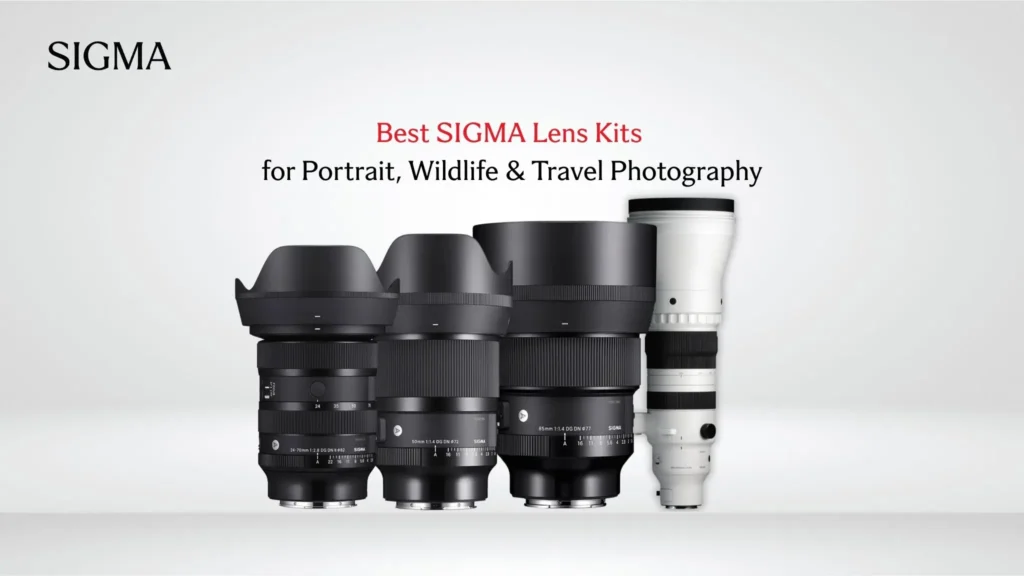
In the high-stakes visual landscape of 2026, professional creators are rapidly moving away from restrictive bundles toward specialized kit lens configurations that offer elite optical performance. While many beginners start their journey with a basic camera kit lens, experienced professionals in Pakistan and beyond understand that the “Art”, “Contemporary” and “Sports” lines from SIGMA provide a level of micro-contrast and edge-to-edge sharpness that standard glass simply cannot match.
Whether you are documenting a high-end, high-pressure wedding in the heart of Karachi or tracking elusive snow leopards across the majestic Gilgit-Baltistan peaks, the right combination of glass determines your ultimate success. This comprehensive guide moves far beyond the average kit lens to explore how SIGMA’s mirrorless-native DG DN series has redefined what a professional sigma lens kit looks like for various high-end niches.
By investing in these meticulously curated pairings, you ensure that your gear never bottlenecks your creativity, allowing for a seamless, professional transition from high-stakes commercial studio work to rugged, unpredictable outdoor expeditions across the country.
What Is a Kit Lens?
A kit lens is the basic zoom lens that usually comes bundled with a camera body when you buy it. It’s designed to cover everyday shooting such as portraits, landscapes, indoor shots at a reasonable cost.
The most common camera kit lens is an 18–55mm f/3.5–5.6 zoom. It’s lightweight and versatile, which makes it great for beginners. But it also comes with real trade-offs. The variable aperture limits low-light performance. The build quality is often plastic-heavy. And the sharpness, especially towards the edges of the frame, can disappoint as your eye gets more trained.
That’s not to say kit lenses are bad. They’re a smart starting point. But most photographers outgrow them quickly, especially once they discover what a dedicated prime or high-quality zoom can actually do.
SIGMA doesn’t make generic kit lenses. Instead, every lens in their lineup is built with a specific purpose and the image quality difference is immediately visible.
Best SIGMA Lens Kit for Portrait Photography
Portrait photography is all about connecting the way light falls on a face, the depth of a gaze, the softness of a background blur. For that, you need a lens with a wide aperture, beautiful bokeh, and sharpness that reveals every fine detail. Here are two SIGMA lenses that kit lens photography enthusiasts and professional portrait shooters both swear by.
Sigma 85mm F1.4 DG DN | Art
If there’s one focal length that portrait photographers globally agree on, it’s 85mm. And SIGMA’s 85mm F1.4 DG DN Art is arguably the finest version of it you can buy today at any price.
At f/1.4, you get a beautifully shallow depth of field that separates your subject from the background with effortless elegance. The bokeh is creamy, smooth, and completely free of the harsh ‘soap bubble’ effect that plagues some competing lenses. The sharpness at centre, even wide open, is stunning, the kind of detail that makes eyes pop and skin textures render naturally.
This lens is built for mirrorless systems (Sony E-mount and L-mount), and its autofocus performance is fast, near-silent, and reliable crucial for shooting subjects in motion or in candid settings. Pakistani photographers working in outdoor portrait sessions, bridal shoots, or studio setups will find this lens transforms their work immediately.
Many portrait photographers in Pakistan prefer the SIGMA 85mm F1.4 Art for studio and wedding photography setups.
Key highlights:
- F1.4 maximum aperture for subject isolation and low-light excellence
- Stunning central sharpness even at widest aperture
- Fast, quiet autofocus ideal for portraits and events
- Premium Art-series build quality with weather-resistant construction
This is the lens you pick up, shoot one frame, and instantly understand why professionals charge what they charge.
Sigma 50mm F1.4 DG DN | Art
The 50mm focal length is often called the “nifty fifty” and for good reason. It’s close to what the human eye sees naturally, which gives your portraits a grounded, authentic feel. SIGMA’s 50mm F1.4 DG DN Art takes that classic perspective and sharpens it to a razor edge.
What makes this lens special is its versatility. Yes, it’s an excellent portrait lens. But it also works brilliantly for street photography, environmental portraits, food photography, and even light travel work. The f/1.4 aperture gives you tremendous creative control; you can shoot in dim Pakistani wedding halls without flash, or blur out a busy Lahore street behind a single subject.
The optical design uses 17 elements including SLD (Special Low Dispersion) glass to minimise chromatic aberration. The result is colour accuracy and contrast that rival lenses costing two or three times as much.
Key highlights:
- Classic 50mm perspective for natural, flattering portraits
- F1.4 aperture for excellent subject separation and low-light use
- SLD glass minimises chromatic aberration and colour fringing
- Versatile enough for portraits, events, travel, and everyday shooting
Best SIGMA Lens Kit for Wildlife Photography
Wildlife photography demands reach, speed, and optical precision often all at once. When you’re photographing birds in Chitral, snow leopards in the northern highlands, or migratory species along the Indus, you simply can’t afford a lens that hunts, hunts, and misses. Here’s a sigma lens kit that wildlife photographers across experience levels rely on.
Sigma 150-600mm DG DN | Sports
This is the wildlife telephoto zoom that changed the game for photographers who wanted serious reach without a seriously painful price tag. The 150-600mm f/5-6.3 DG DN Sports covers a massive focal range from medium telephoto all the way to super-telephoto in a single, well-built package.
The autofocus system uses a high-torque, ring-type AF motor combined with SIGMA’s latest algorithms, delivering fast and reliable subject tracking. For wildlife photographers, that means fewer missed shots of a bird in flight or a predator mid-stride. The Sports designation also means this lens is built for tough conditions; it has dust and splash-resistant construction that handles Pakistan outdoor environments well.
At 600mm, you get enough compression to isolate subjects against distant backgrounds. The image stabilisation system is highly effective, allowing handholding at longer shutter speeds than you’d expect at this focal length. Whether you’re perched in a hide or tracking from a vehicle, this lens delivers consistently sharp, detailed results.
Key highlights:
- 150–600mm zoom range for versatile wildlife coverage
- Fast, accurate AF tracking for moving subjects
- Dust and splash-resistant Sports-grade build quality
- Built-in image stabilisation for sharp handheld shooting
Sigma 300-600mm F4 DG OS | Sports
If the 150-600mm is the everyday wildlife workhorse, the 300-600mm F4 DG OS Sports is the professional-grade precision tool. The constant f/4 aperture throughout the entire zoom range is a significant advantage; it means your exposure doesn’t change as you zoom, and you get consistently better light intake than variable-aperture alternatives.
The f/4 aperture also enables faster shutter speeds, which is exactly what you need when shooting fast-moving birds, mammals, or wildlife in low-contrast environments like dawn and dusk, the golden hours that produce the most dramatic wildlife images.
SIGMA engineered this lens with a hypersonic motor autofocus system, making it extremely responsive. Pair that with optical image stabilisation and you have a lens that handles handheld shooting at 600mm with surprising confidence. The build is robust, weather-sealed, and clearly designed for field use rather than studio shelves.
Key highlights:
- Constant f/4 aperture throughout full 300–600mm zoom range
- Hypersonic AF motor for rapid, accurate subject acquisition
- Superior low-light performance compared to variable aperture alternatives
- Professional Sports-grade weather sealing for field durability
Best SIGMA Lens Kit for Travel Photography
Travel photography asks a lot from your gear. You need quality without excessive weight, flexibility without compromise, and reliability when you’re miles from the nearest camera shop. This sigma lens kit for travel photographers solves that equation beautifully.
Sigma 24-70mm F2.8 DG DN II | Art
The 24-70mm f/2.8 zoom is the classic “holy trinity” workhorse the range that covers wide-angle architecture, standard street shots, and light telephoto portraits all in one lens. SIGMA’s second-generation 24-70mm F2.8 DG DN II Art improves on an already excellent lens with better autofocus performance, refined optical construction, and a more compact build.
For travel photographers in Pakistan shooting the intricate tile work of Lahore’s Wazir Khan Mosque, the sweeping valleys of Hunza, or the busy bazaars of Peshawar this lens handles every scene with confidence. The constant f/2.8 aperture keeps your options open in difficult lighting. The Art-series glass delivers the sharpness and contrast that make travel images frame-worthy.
The autofocus is fast, accurate, and well-suited to street photography where moments pass in seconds. The second-generation version is also noticeably lighter than its predecessor, which matters enormously on long travel days.
Key highlights:
- 24–70mm covers wide, standard, and short-telephoto in one lens
- Constant f/2.8 for consistent exposure and better low-light capability
- Improved autofocus performance in the second-generation version
- Lighter and more compact than comparable travel zoom alternatives
Sigma 16-28mm F2.8 DG DN | Contemporary
For landscapes, architecture, and environmental storytelling, a wide-angle lens is essential. The Sigma 16-28mm F2.8 DG DN Contemporary delivers an impressive ultra-wide perspective with a fast, constant f/2.8 aperture a combination that’s genuinely rare in this price segment.
What sets this lens apart for travel use is its size and weight. It’s remarkably compact for an f/2.8 wide-angle, making it easy to carry alongside your primary zoom without the bag feeling like a burden. Despite its smaller footprint, it produces images with excellent edge-to-edge sharpness, minimal distortion, and natural colour rendering.
Pakistani travel photographers exploring the Badshahi Mosque, the ancient ruins of Mohenjo-daro, or the dramatic mountain passes of the Karakoram Highway will find this lens captures the grandeur and scale of these locations in a single, breathtaking frame. Pair it with the 24-70mm and you have a two-lens travel kit that covers virtually every situation.
Key highlights:
- 16–28mm ultra-wide range ideal for landscapes and architecture
- Constant f/2.8 aperture for versatility in varied lighting conditions
- Compact, lightweight build makes it an ideal travel companion
- Excellent edge-to-edge sharpness with natural distortion control
SIGMA Lens Kit Guide for Different Photography Styles
| Photography Style | Recommended SIGMA Lens Kit | Why It Works |
| Portrait Photography | 85mm F1.4 Art + 50mm F1.4 Art | Produces beautiful background blur and sharp facial detail for portraits and bridal shoots. |
| Wildlife Photography | 150-600mm F5-6.3 Sports + 300-600mm F4 Sports | Long telephoto reach with strong autofocus tracking for birds and distant wildlife subjects. |
| Travel Photography | 24-70mm F2.8 Art + 16-28mm F2.8 Contemporary | Versatile focal range for landscapes, architecture, and street photography while staying lightweight. |
Why SIGMA Cameras Don’t Come With a Kit Lens
You might wonder if SIGMA makes lenses, do their camera bodies come with a kit lens included? The answer is no, and there’s a clear, practical reason for that. SIGMA’s camera division produces the fp L and BF compact, minimalist full-frame mirrorless bodies built for professionals and filmmakers who already have a lens system in place. These cameras are designed to be paired with the photographer’s chosen glass, not bundled with a generic starter lens. SIGMA’s philosophy is precision and intentionality, and that extends to how their ecosystem is structured.
The benefit for you as a buyer is significant. Rather than paying for a lens you’ll outgrow in six months, you invest directly in the glass that matches your actual shooting needs. A portrait photographer pairs the Sigma cameras with the 85mm Art. A travel shooter pairs it with the 24-70mm. A wildlife specialist reaches for the 150-600mm Sports. It’s a lens-first approach to photography and for serious photographers, that’s exactly the right way to build a system. When you buy SIGMA, you’re building a kit lens upgrade, not accepting one.
Conclusion – Upgrade Your Photography with SIGMA Lens Kits
The right glass changes everything. Whether you’re shooting portraits in a studio, tracking wildlife across open terrain, or documenting a journey through Pakistan’s most breathtaking landscapes, SIGMA has a purpose-built lens that outperforms the standard kit lens at every level. Each lens in this guide was chosen based on real-world shooting performance, optical quality, and value, not just spec sheets. The sigma lens kit options we’ve covered here represent some of the best investment decisions a photographer can make, regardless of experience level.
Ready to take your photography further? Explore the full SIGMA lens range at Sigma Pakistan and find the glass that fits your vision, your system, and your story.
Frequently Asked Questions
What is a kit lens?
A kit lens is the basic lens that usually comes bundled with a camera when you buy it. It is designed to be versatile and beginner-friendly. Most kit lenses offer a standard zoom range, such as 18-55mm, allowing photographers to shoot everyday subjects like landscapes, portraits, and casual photography.
Should I upgrade from a kit lens?
Upgrading from a kit lens is recommended once you want better image quality, sharper photos, or improved low-light performance. Kit lenses are great for learning, but advanced lenses often provide wider apertures, faster autofocus, and stronger optical performance, helping photographers achieve more professional-looking images.
What is the best lens after a kit lens?
After a kit lens, many photographers upgrade to a fast prime lens such as a 50mm f/1.8 or 35mm f/1.4. These lenses provide sharper images, better background blur, and stronger low-light performance. They are excellent for portraits, everyday photography, and improving overall image quality.
Can you shoot wildlife with a kit lens?
Yes, you can shoot wildlife with a kit lens, but it has limitations. Most kit lenses do not have long zoom ranges, which makes it difficult to capture distant animals. For better wildlife photography results, photographers usually prefer telephoto lenses with longer focal lengths such as 200mm or more.
Are SIGMA lenses better than kit lenses?
Yes, SIGMA lenses are generally better than kit lenses in terms of optical quality, build construction, and performance. They often feature wider apertures, sharper optics, and faster autofocus systems. Many photographers upgrade to SIGMA lenses to achieve higher image quality and more creative control.
