
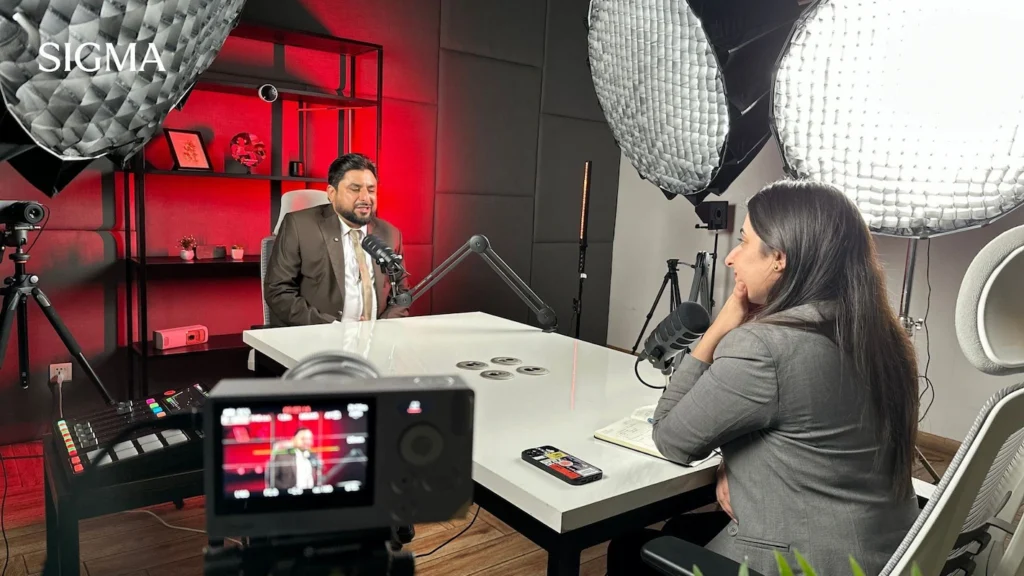
Your audio sounds clean, but the video looks cramped, stretched or oddly tight. In most cases, the lens is the problem, not the camera. The best lens for podcast recording depends on room depth, sensor size, number of speakers and framing.
For many setups, 24-35mm full-frame equivalent works well for wide or two-person shots. For solo talking heads, 35-50mm is a strong range. APS-C users need shorter lenses, such as 16mm or 23mm, to get a similar view. This guide shows which focal length fits your room and which SIGMA lens matches your setup.
What Focal Length Is Best for Podcast Video?
A 35mm full-frame equivalent is a balanced starting point for most podcasts. Go wider to 24mm in small rooms, and longer to 50mm when you have more space.
There is no single best focal length for podcast video, because every room is different. The table below shows where each podcast lens focal length fits best.
24mm
APS-C equivalent: 16mm
Small rooms and two-person wide shots
35mm
APS-C equivalent: 23mm
Solo podcasts, talking heads and desk framing
50mm
APS-C equivalent: 30–33mm
Tighter single shots in larger rooms
70mm+
APS-C equivalent: 45–56mm
Close-up second camera when space allows
Treat these as starting points, not fixed rules. The best lens for podcast video gives natural framing from where your camera can actually sit. Camera distance and framing shape the final look as much as the lens does.
What Lens Should You Use in a Small Podcast Room?
In a small room, use a wider lens so the camera can sit close without cutting off heads. Around 16mm on APS-C or 24mm on full frame is a safe start.
Small-room starting point
APS-C
Start around 16–23mm
Full frame
Start around 24–35mm
Many creators in Pakistan record in a spare bedroom, a home office or the back room of a shop. These spaces leave little distance between camera and chair. The best lens for small podcast room setups frames you comfortably without pushing the camera into a wall.
The 24mm vs 35mm podcast choice mostly comes down to room depth:
- 24mm shows more of the room and fits tight spaces easily.
- 35mm looks more natural but needs extra distance.
- Pick 24mm for two people in a small room.
- Pick 35mm for one person when the camera can move back a little.
APS-C Small-Room Setup
An APS-C lens for podcast use in a small room should start between 16mm and 23mm. Good starting points:
- 16mm: About 24mm equivalent. Good for two people or very tight rooms.
- 18mm: About 27mm equivalent. Easy to reach with an 18-50mm zoom.
- 23mm: About 35mm equivalent. Natural framing for one person with a desk.
Full-Frame Small-Room Setup
A full frame lens for podcast work in a small room should sit between 24mm and 35mm. Good starting points:
- 24mm: Fits two people or a full desk setup.
- 28mm: A middle ground with a slightly tighter view.
- 35mm: Natural perspective for one speaker, if the room allows.
One caution applies to both formats. Do not place a wide lens very close to someone’s face. Noses and foreheads can look larger, and faces near frame edges can stretch. Keep the speaker near the centre and give the camera some breathing room.
35mm vs 50mm for Talking-Head Videos: Which Looks Better?
Neither wins in every case. 35mm suits smaller rooms and wider framing, while 50mm gives a tighter, more isolated shot when you have space.
The 35mm vs 50mm for talking head choice is really about room size and camera distance.
35mm
Framing: Upper body, desk and more of the set
Room: Small to medium
Background: More visible context
Feel: Open and relaxed
- Better when space is limited
- Good for desk setups
- Shows more of the environment
50mm
Framing: Face and shoulders
Room: Medium to large
Background: Tighter, softer-looking
Feel: Focused and cinematic
- Stronger subject isolation
- Needs more camera distance
- Best for tighter presenter shots
What Lens Works Best for a One-Person Podcast?
For a solo podcast, start with 23-30mm on APS-C or 35-50mm on full frame. This range gives a natural, balanced talking-head shot in most home studios.
The right lens for one person podcast recording depends on how much space sits behind the camera. In our experience advising creators, most solo APS-C podcasters settle on 23mm.
Solo podcast starting range
23–30mm
35–50mm
Use the wider end when:
- The room is small
- You want your desk, shelves or set visible
- You move your hands or lean while talking
Use the longer end when:
- The room is deeper
- You want a tight, isolated presenter shot
- A busy background needs softening
What Lens Works Best for a Two-Person Podcast?
For two people in one frame, use a wide shot around 16-23mm on APS-C or 24-35mm on full frame. With more cameras, add longer lenses for individual close-ups.
A lens for two person podcast setups has a harder job than a solo lens. It must fit both speakers, the table and some space around them. Interviews follow the same logic, so the best lens for interview video depends mostly on your camera count.
| Camera role | APS-C | Full frame |
|---|---|---|
| Wide master shot | 16–23mm | 24–35mm |
| Individual close-up | 30–56mm | 50–85mm |
| Single flexible camera | 18–50mm zoom | 24–70mm zoom |
Treat these numbers as flexible guides. Seat both speakers at a similar distance from the camera. That keeps both faces sharp and equally sized in the frame.
Prime vs Zoom Lens for Podcast Video
Choose a prime lens for a fixed studio with one consistent look. Choose a zoom when framing changes between guests, shows or content types.
The prime vs zoom for podcast decision depends on how often your set changes.
Prime Lens
Best for a fixed studio and consistent framing.
- Often wider aperture
- Stronger background blur
- Useful in lower light
- Reframing usually means moving the camera
Zoom Lens
Best for changing guests and flexible framing.
- Fast reframing
- One lens covers several shot sizes
- Useful for shared studios
- Often uses a practical constant F2.8 aperture
Choose a prime if:
- The camera stays in one place
- Your room and set rarely change
- Low light is a concern
- You want stronger background blur
Choose a zoom if:
- Different guests need different framing
- You shoot wide, medium and close-up from one position
- You also record product videos or client interviews
F1.4 vs F2.8 for Podcast Video: Which Aperture Is More Practical?
F2.8 is usually more practical for podcasts, especially with two speakers or moving hosts. F1.4 helps most in dim rooms and solo shots with strong background blur.
The F1.4 vs F2.8 for podcast decision is mostly about focus safety.
F1.4
Best for: Solo hosts and low light
- More background blur
- More light reaches the sensor
- Strong subject separation
- Thin focus zone requires more care
F2.8
Best for: Most podcast recording
- More focus safety
- Better for two speakers
- More forgiving when hosts move
- Common on flexible zoom lenses
Many creators buy an F1.4 prime and record at F2 to F2.8. That keeps the low-light headroom and adds focus margin. Our F1.2 vs F1.4 vs F2.8 guide explains aperture choice in more depth.
APS-C vs Full Frame: Why the Same Focal Length Looks Different
An APS-C sensor crops the image, so any lens looks tighter than on full frame. Multiply the focal length by about 1.5x, or 1.6x on Canon, for the equivalent view.
That is why a 35mm lens feels wide on full frame but close to a 50mm view on APS-C. Quick examples on a 1.5x crop body:
APS-C focal length → approximate full-frame view
≈ 24mm
≈ 35mm
≈ 45mm
≈ 27–75mm
Approximate equivalents for a 1.5× APS-C crop.
Always check your sensor size before picking a focal length. Our lens mount and sensor guide covers crop factor in detail.
How Far Should the Camera Be From the Speaker?
No single distance suits every setup. Longer focal lengths need more distance to frame the same shot, so set distance for natural perspective first.
The right camera distance for talking head video depends on:
- Focal length
- Sensor size
- Framing, such as face, shoulders or upper body
- The perspective you want
As a rough guide, face-and-shoulder framing on full frame needs about 1.1 m at 35mm. At 50mm, the same framing needs about 1.5 m. Your numbers will shift with sensor size and framing style.
About 1.1 m
Face-and-shoulder starting guide
About 1.5 m
Face-and-shoulder starting guide
A simple method works in most rooms:
- Sit exactly where you will record.
- Measure the space available for the camera in front of you.
- Leave some depth behind you for background separation.
- Pick the focal length that frames you well from that spot.
Which Lens Features Matter Most for Podcast Video?
Quiet autofocus and reliable face tracking matter most. Aperture, focus breathing and the correct mount come next.
- Quiet autofocus: Motor noise should never reach your microphone.
- Reliable face and eye AF: Hosts lean forward and back all the time.
- Low focus breathing: The frame stays steady when focus shifts between speakers.
- Wide enough aperture: It helps in dim rooms and separates you from the background.
- Correct camera mount: Match Sony E, Canon RF, Nikon Z, Fujifilm X or L-Mount. Some SIGMA lenses come in selected mounts only.
Best SIGMA Lenses for Podcast Video
The best Sigma lens for podcast work depends on your sensor and room. The 23mm F1.4 suits most solo APS-C setups, while the 24-70mm F2.8 II suits flexible full-frame studios.
Quick SIGMA lens picks by setup
SIGMA 16mm F1.4 DC DN | Contemporary
This APS-C prime gives about a 24mm equivalent view. It suits tight rooms and two-person wide shots.
- Best for: Small rooms, wide master shots, two-person APS-C setups
SIGMA 23mm F1.4 DC DN | Contemporary
This lens gives about a 35mm equivalent view on APS-C. It is a balanced choice for solo talking heads.
- Best for: One-person podcasts, desk setups, natural environmental framing
SIGMA 30mm F1.4 DC DN | Contemporary
This prime gives about a 45mm equivalent view. It suits creators with more room behind the camera.
- Best for: Tighter solo shots and APS-C close-up cameras
SIGMA 18-50mm F2.8 DC DN | Contemporary
This zoom covers about 27-75mm equivalent with a constant F2.8 aperture. One lens handles wide, medium and tight framing.
- Best for: Flexible APS-C studios, changing guests, one-lens setups
SIGMA 35mm F1.4 DG DN | Art
This full-frame prime gives a natural perspective and strong background separation. It works well for solo podcasts and interviews.
- Best for: Solo hosts, interviews, low-light studios
- Available for Sony E and L-Mount only
SIGMA 24-70mm F2.8 DG DN II | Art
This zoom covers wide master shots and tight close-ups from one camera position. It is the most flexible full-frame choice for professional studios.
- Best for: Agencies, commercial studios, changing guest positions
- Available for Sony E and L-Mount only
SIGMA lenses for Canon RF are made for APS-C bodies only. Check mount availability with SIGMA Pakistan before you order.
Best Podcast Lens by Setup
This table narrows down the best lens for podcast setups by room size and sensor.
| Setup | Starting focal length | SIGMA example |
|---|---|---|
| Small APS-C room | 16–23mm | 16mm F1.4 or 23mm F1.4 |
| Solo APS-C podcast | 23–30mm | 23mm F1.4 or 30mm F1.4 |
| Flexible APS-C studio | 18–50mm | 18–50mm F2.8 |
| Small full-frame room | 24–35mm | 35mm F1.4 Art or 24–70mm F2.8 II |
| Solo full-frame podcast | 35–50mm | 35mm F1.4 Art or 50mm F1.4 Art |
| Flexible pro studio | 24–70mm | 24–70mm F2.8 II |
| Close-up second camera | 50mm+ FF / 30mm+ APS-C | 50mm F1.4 Art or 56mm F1.4 |
Use this as a starting point only. Room size and framing still decide the final choice.
Common Podcast Lens Mistakes
Most podcast framing problems start when the lens is chosen before the shot is planned. Avoid these five common mistakes.
Wide lenses used too close can exaggerate facial features. Step back or choose a slightly longer focal length.
A 50mm lens needs more camera distance than many small rooms allow.
If speakers sit at different distances, one face may fall outside the focus zone. Use more depth of field.
A focal length gives a tighter field of view on APS-C than on full frame.
Decide the number of speakers, framing, room depth and camera position before buying the lens.
Finding the best lens for podcast recording starts with the shot, not the spec sheet. Once you know your room, pick a SIGMA lens from SIGMA Pakistan in the right mount for your camera. For mount or focal length advice, visit the Hope Enterprises display and service centre at Japan Street Nisbat Road, Lahore.
Frequently Asked Questions
What is the best focal for podcast video?
35mm on full frame is the safest choice for most podcasts. Small rooms suit 24mm, while bigger spaces allow 50mm. On APS-C, 23mm gives the same balanced view.
Is 35mm good for talking-head videos?
Yes. 35mm is one of the most balanced focal lengths for talking heads, or about 23mm on APS-C. It shows the presenter and some background without needing a large room.
Is 50mm too tight for a podcast?
Not if you have space. On full frame, a 50mm needs about 1.5 m for face and shoulder framing. In small rooms, 35mm is usually easier to work with.
What lens should I use for a two-person podcast?
Choose by shot type. A wide shot of both speakers needs 24-35mm on full frame or 16-23mm on APS-C. Individual close-ups need about 50-85mm on full frame.
Is F1.4 or F2.8 better for podcast video?
For most podcasts, F2.8 is the better choice. Its deeper focus zone forgives leaning and movement. Save F1.4 for solo shows in low light where soft backgrounds matter.
Which SIGMA lens is best for a small podcast room?
For APS-C cameras, the SIGMA 16mm F1.4 DC DN Contemporary fits tight rooms and two-person shots. Full-frame users can start with the 24-70mm F2.8 DG DN II Art at 24mm.
