
Choosing the right lens changes everything in couple photography. It shapes the mood, the distance, the background blur and ultimately, how the photo feels. However, ask any working photographer: the lens matters more than the camera body. A sharp, flattering lens turns simple couple poses into timeless memories. A wrong lens choice? It flattens faces, kills the background, and ruins the moment.
In 2026, photographers have more lens options than ever. But most couples and photographers still debate one classic question: 50mm or 85mm?
This guide answers that clearly. We’ll cover the top lenses, real shooting scenarios, camera settings, and common mistakes. Additionally Whether you’re shooting a cozy indoor session or a golden-hour outdoor shoot, this guide helps you make the right call confidently. Mastering the right lens will also improve your couple poses by making them look more natural and visually appealing.
What Are the Best Lens for Couple Photography?
There’s no single “perfect” lens. The best lens for couple photography depends on your shooting style, location, and how close you want to be to the couple. In fact, most professional photographers agree: prime lenses between 50mm and 85mm deliver the most flattering, natural-looking results for couples.
Here’s why. Focal length affects how faces look. For example, wide lenses (below 35mm) can distort features. Telephoto lenses (above 135mm) compress depth unnaturally. The sweet spot? 50mm to 85mm. It mimics how the human eye sees the world.
For couple poses, you want a lens that creates gentle background separation, keeps both faces sharp, and allows natural movement between subjects. Fast aperture lenses (f/1.4, f/1.8) also matter. As a result, they let in more light and produce that creamy bokeh background photography effect, the dreamy blur that makes couple portraits look cinematic and professional. Lens quality directly affects your final image. Invest wisely.
Top Lenses for Couple Photography
Not every lens works equally well for couples. To begin with, here are four tried-and-tested options that real photographers use daily each with its own strengths depending on your shoot style and story.
50mm Lens – Natural Look
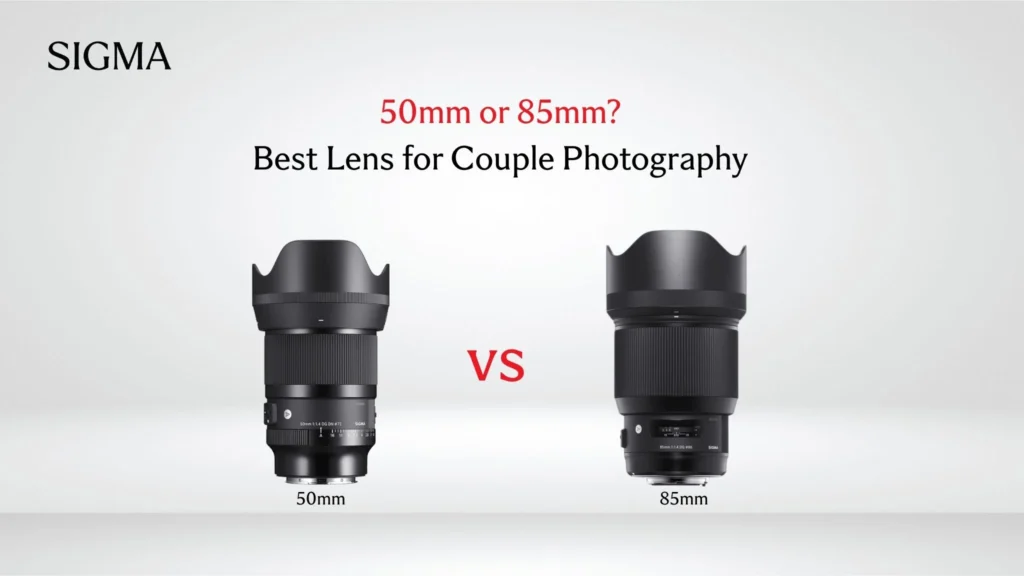
The 50mm is called the “nifty fifty” for a reason. It sees the world almost exactly like the human eye. Therefore, that makes a couple poses look natural, unposed, and real. This lens works beautifully in both tight spaces and open environments. It’s lightweight, affordable, and sharp even at wider apertures. The Sigma 50mm f/1.4 Art lens, for instance, delivers exceptional sharpness with gorgeous background separation.
For photographers starting out, the 50mm is the best first prime lens. Moreover, it handles photography lighting for couples in low-light venues without a flash. The rendering is clean, colors are accurate, and the focus is reliable. If you shoot documentary-style or candid couple poses, the 50mm is your go-to companion on every shoot.
85mm Lens – Best for Romantic Portraits
The 85mm is widely considered the king of portrait lenses. It produces flattering facial compression, buttery background blur, and a natural separation between subject and environment. For romantic couple photography, the 85mm shines. Consequently, it lets you shoot from a comfortable distance giving the couple space to be natural while still capturing intimate, close expressions.
The Sigma 85mm f/1.4 Art is a professional favorite. Similarly, it renders skin tones beautifully and produces one of the smoothest bokeh qualities available at this focal length. The extra distance also means you’re less intrusive during emotional moments like a quiet look, a soft kiss, or a genuine laugh. If you shoot one lens for couple portraits, make it the 85mm.
35mm Lens – Wide & Storytelling
The 35mm lens is a natural storyteller. It captures the couple and their environment together with the golden field, the winding city street, the rustic venue glowing behind them. This focal length works best when location is part of the story. Meanwhile It’s ideal for lifestyle shoots where movement and context matter equally. Couple photoshoot poses that involve walking, spinning, or genuinely interacting with a scene look incredible on a 35mm. The slight wide angle adds energy, depth, and a sense of place that tighter lenses simply can’t deliver.
On the other hand, avoid shooting tight close-up portraits on a 35mm. At close distances, faces can look slightly stretched and unnatural. Step back, include the surroundings, and let the environment breathe. For wide-frame, cinematic couple storytelling, the 35mm delivers results that neither the 50mm nor the 85mm can replicate. It’s a powerful creative tool worth having in your bag.
24-70mm Lens – Versatile Option
If you only want to carry one lens for a full couple sessions, the 24-70mm f/2.8 is your answer. In other words, it covers wide storytelling shots at 24mm and clean, flattering portraits at 70mm all without changing lenses mid-shoot. Think of it as the portrait lens for couples that zooms directly into emotions. The Sigma 24-70mm f/2.8 Art delivers pro-level sharpness and consistent exposure across the entire focal range. At the same time, it handles outdoor couple shoot settings beautifully from sweeping landscape shots to tight, emotional close-ups that feel genuinely intimate.
Transitioning between wide and portrait framing takes seconds. That speed matters during unpredictable moments: a sudden laugh, a stolen glance, an unscripted kiss. The tradeoff? It’s heavier and more expensive than a prime lens. Even so, for wedding and event photographers who need real flexibility without sacrificing image quality, the 24-70mm is genuinely irreplaceable. It’s the workhorse lens that consistently delivers every single shoot.
50mm vs 85mm Lens for Couple Photography
Both focal lengths are excellent. But they serve different creative purposes. Your choice should depend on shooting space, style, and intended output. To clarify, here’s a clear breakdown to help you decide.
| Feature | 50mm Lens | 85mm Lens |
| Focal Length | 50mm | 85mm |
| Best Use | Environmental, candid | Portraits, close-ups |
| Working Distance | Closer to couple | Further from couple |
| Background Blur | Good bokeh | Stronger, creamier bokeh |
| Face Flattery | Natural | More flattering compression |
| Indoor Use | Excellent | Needs more room |
| Outdoor Use | Excellent | Excellent |
| Price Range (Sigma) | More affordable | Higher investment |
| Ideal For | Lifestyle shoots | Romantic portrait sessions |
| 50mm vs 85mm for portraits | Natural feel | Cinematic feel |
Which Lens Should You Choose?
Here’s the honest answer: it depends on where and how you shoot. Choose the 50mm if you photograph in smaller venues, tight indoor spaces, or love a candid, documentary style. In contrast, it gives you more flexibility without stepping too far back. Choose the 85mm if you prioritize beautiful portrait compression, smooth bokeh, and a slightly more cinematic look. It’s the better choice for emotional close-ups and couple photo pose sessions focused on expressions.
Many professional photographers carry both. Ultimately, start with the 50mm if you’re on a budget. Upgrade to the 85mm when you’re ready to level up your portrait game. Either way, a Sigma Art lens in either focal length will exceed your expectations in sharpness, color, and build quality. The right choice here directly improves how your couple poses translate into professional-quality images.
Why Lens Choice Matters More Than Poses
Photographers often obsess over couple poses. But here’s something most photography guides don’t tell you: the lens shapes the story more than the pose ever will. A couple standing still on an 85mm f/1.4 looks completely different from the same pose on a 24mm. Because of this, the background changes. The facial proportions shift. The emotional weight of the image transforms entirely.
Lens choice controls compression, depth of field, and spatial relationship between subjects. In addition, it decides how much of the world exists behind the couple and how blurred or sharp that world appears. Good photography poses for couples are important. But the right lens makes even simple, relaxed poses look extraordinary. Invest in a quality lens before you invest in posing books or presets.
Best Camera Settings for Couple Photography
Getting sharp, beautiful couple shots requires more than just a good lens. Equally important, your camera settings matter equally. Here are the settings professionals rely on:
- Aperture: Shoot between f/1.8–f/2.8 for background blur. Use f/4–f/5.6 when you want both faces in sharp focus.
- Shutter Speed: Use 1/200s or faster to freeze natural movement. Never go below 1/125s handheld.
- ISO: Keep ISO between 100–800 in daylight. In low light, push to ISO 1600–3200 with a fast prime lens.
- White Balance: Set a custom white balance outdoors. Avoid Auto WB in mixed lighting conditions.
- Focus Mode: Use continuous autofocus (AF-C) for moving couples. Single-point AF for still, posed shots.
- Exposure Mode: Aperture Priority (Av) gives you consistent control in changing light conditions.
- Metering Mode: Use evaluative/matrix metering for most scenes. Spot metering for backlit portraits.
Best Lens for Different Couple Photography Styles
Every couple session has its own mood and setting. As a guide, the right lens shifts based on the story you’re telling. Below is a style-by-style breakdown so you always pick the right tool.
Engagement Shoots
Engagement photoshoot ideas almost always involve a mix of close portraits and wide lifestyle shots. For this reason, the 50mm is incredibly versatile. It captures the joy, the laughter, and the genuine connection between two people without feeling intrusive.
Shoot wide open at f/1.8 for soft, glowing portraits. Step back and shoot at f/4 for a wider environmental shot that shows the location. The 50mm lets you do both without switching lenses. For golden-hour engagement sessions, the way the 50mm renders warm light is simply beautiful. Add a reflector for fill light, and you have everything you need for stunning, natural engagement photos that couples genuinely love.
Wedding Photography
Wedding couple poses demand a lens that performs under pressure, low light, unpredictable moments, fast movement. Notably, the 85mm is the top choice for wedding portrait sessions. It flatters faces, separates subjects from busy backgrounds, and produces magazine-worthy results.
For the ceremony and reception, the 24-70mm f/2.8 offers the flexibility to cover wide room shots and intimate close-ups without lens changes. Many wedding photographers shoot with two camera bodies, one with an 85mm for portraits, one with a 24-70mm for coverage. This combination covers every moment from the first look to the final dance with consistency, quality, and reliability you can deliver to clients confidently.
Outdoor Sessions
An outdoor couple shoot is where lenses truly show their character. As expected, the 85mm excels here. It compresses background trees, mountains, or city skylines into beautiful, smooth backdrops. Combined with golden-hour light, the results are breathtaking. For wider environmental outdoor shots, the 35mm or 24-70mm gives you that expansive, cinematic feel. Shooting couple pictures poses outdoors at f/2.8 with the sun behind the couple creates a natural backlit glow that looks stunning. Use a lens hood to control flare. Shoot during golden hour one hour after sunrise or before sunset for the warmest, softest, most flattering natural light available to any photographer.
Indoor Sessions
Indoor sessions bring challenges: low light, tight spaces, and mixed artificial lighting. To solve this, the 50mm f/1.4 is the strongest choice for indoor couple photography. It handles low light beautifully without flash, keeping the atmosphere natural and warm.
For very small rooms, a 35mm gives you breathing room without sacrificing bokeh quality. Avoid wide-angle lenses below 24mm indoors; they create distortion that unflatters both faces and spaces. For indoor lighting setups for couple photography, position the couple near a window for soft, directional natural light. Combine that with a fast Sigma prime lens and you’ll produce warm, intimate indoor portraits that feel authentic and beautifully lit without complicated lighting setups.
Common Mistakes in Couple Photography
Even experienced photographers make avoidable errors. Most importantly, knowing these pitfalls helps you shoot smarter and deliver better couple poses every session.
- Shooting too wide: Focal lengths below 35mm distort faces and create an unflattering look in close portrait shots.
- Using f/1.4 with two people: At f/1.4, depth of field is razor-thin. One face will often be out of focus. Use f/2.0–f/2.8 for two-person shots.
- Wrong working distance: Standing too close with an 85mm is difficult indoors. Know your lens’s minimum focusing distance before the shoot.
- Ignoring background: A cluttered background kills even the best pose. Always check what’s behind the couple before shooting.
- Overposing: Stiff, unnatural poses kill authenticity. Direct gently, then let the couple interact naturally between poses.
- Wrong autofocus point: Always focus on the nearest eye. Missed eye focus ruins otherwise perfect portraits.
- Shooting in harsh midday light: Midday sun creates unflattering shadows. Shoot in shade or during golden hour whenever possible.
Couple Photography Tips
- Communicate and Connect: Talk to the couple before and during the shoot. Understanding their personalities helps capture natural interactions and genuine expressions.
- Use Movement: Encourage walking, spinning, or playful gestures. Movement creates candid moments and adds life to couple poses.
- Mind the Light: Golden hour is ideal for soft, flattering light. Avoid harsh midday sun and use reflectors or diffusers to balance shadows.
- Focus on Interaction: Instead of rigid poses, direct the couple to interact whispering, laughing, or holding hands. Authentic moments make photos emotionally engaging.
- Experiment with Angles: Shoot from high, low, and side perspectives. Different angles add variety, highlight expressions, and enhance background storytelling.
Where to Buy Original Sigma Lenses in Pakistan
Buying original Sigma lenses in Pakistan is straightforward when you know where to look. First, Sigma Pakistan’s official website is your most reliable starting point. It lists all available lenses, current pricing, and warranty information giving you full confidence in what you’re buying.
Sigma Pakistan also operates through an extensive authorized dealers network spread across major cities including Karachi, Islamabad, and Lahore. If you’re in Lahore, head straight to Nisbat Road camera market; it’s the city’s most established hub for camera gear. Multiple authorized dealers there stock genuine Sigma lenses with official warranty support.
Buying from authorized sources protects you from counterfeit products, ensures manufacturer warranty, and gives you access to proper after-sales service. Whether you’re investing in the Sigma 50mm Art, 85mm Art, or the versatile 24-70mm f/2.8, always purchase from verified Sigma-authorized dealers. Your gear investment deserves that protection.
Final Thoughts
The debate between 50mm and 85mm doesn’t have a single winner, it has a right answer for each situation. In conclusion, the couple photography lens is the one that fits your shooting style, your space, and your creative vision. Start with the 50mm if you’re building your kit. Add the 85mm when you’re ready for elevated portrait work. Both lenses, especially in Sigma’s Art series, deliver exceptional sharpness, beautiful color rendering, and professional-grade bokeh that clients genuinely notice.
Great couple photography is about more than gear. It’s about light, timing, connection, and trust. But the right lens makes every one of those elements shine brighter. When all these elements come together, even simple couple poses can turn into powerful, storytelling images. Invest in quality glass. Learn your focal lengths. And go create photos that couples will treasure for a lifetime.
Frequently Asked Questions
What is the best lens for couple photography?
The 85mm lens is widely considered the best for couple photography. It flatters faces, creates beautiful background blur, and gives couples natural space to interact. The 50mm is a close second more affordable and incredibly versatile for both candid and portrait-style couple sessions.
Is 50mm or 85mm better for couples?
Both are excellent choices. The 50mm works better in tight spaces and lifestyle shoots. The 85mm delivers more flattering facial compression and creamier bokeh for romantic portraits. Many photographers carry both. If you can only choose one, the 85mm wins for pure portrait quality.
What aperture is best for couple photos?
Shoot at f/2.0 to f/2.8 when photographing two people together. This keeps both faces sharp while still blurring the background beautifully. Avoid f/1.4 for two-person shots; the depth of field becomes too shallow and one face will likely fall out of focus.
How do couples pose naturally?
Couples pose naturally when they focus on interaction instead of stiff positioning. Encourage walking, talking, or laughing together. Give simple directions rather than strict poses. Capture candid moments between movements. This approach creates genuine expressions and emotional connection, which results in more authentic and visually appealing photographs.
Which lens gives blurry background in photos?
Fast prime lenses with wide apertures create the blurriest backgrounds. The Sigma 85mm f/1.4 and 50mm f/1.4 are top choices for stunning bokeh background photography. The longer the focal length and wider the aperture, the more separated and creamy your background blur will appear in photos.
