
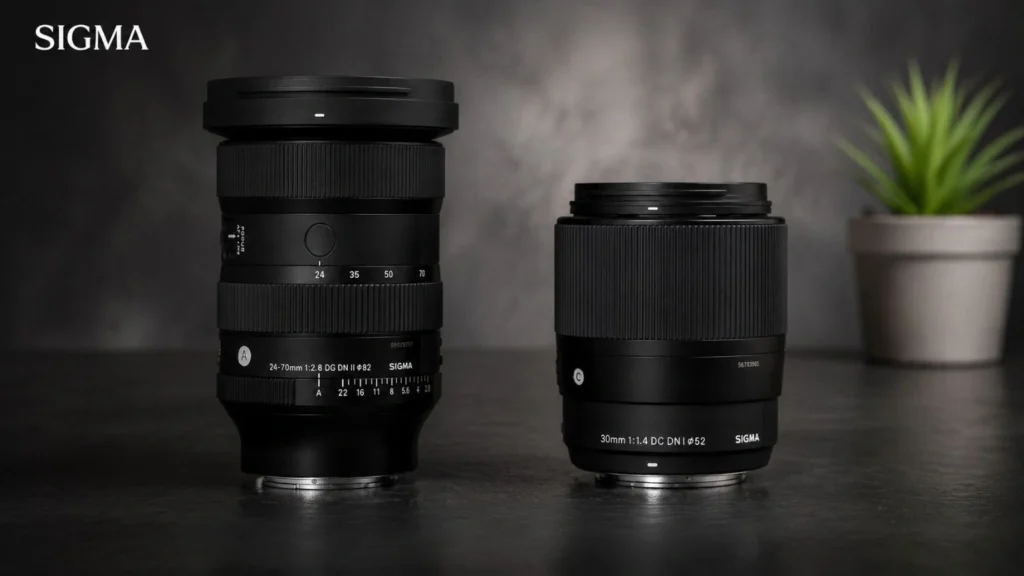
Choosing between Sigma DC DN vs DG DN lenses comes down to one factor: your camera’s sensor size. Many buyers mix up these letters when shopping for their first Sigma lens, leading to a wrong purchase. Sigma labels every mirrorless lens with letters that tell you exactly which sensor it’s built for. Getting this right saves you money and avoids compatibility mistakes.
This guide breaks down the difference in plain terms, built for Pakistani photographers buying their next lens.
What Do DC, DG, and DN Actually Mean?
Sigma uses three letter codes on every lens name, and each one tells you something specific. DG refers to sensor coverage, DC refers to crop sensor design, and DN means the lens is built for mirrorless mounts. Understanding these three codes is the first step in the dc dn vs dg dn decision.
DG = Full-Frame Lenses
DG stands for lenses designed to cover a full-frame sensor completely. These lenses project a larger image circle, matching the size of a 35mm sensor. Sigma full-frame lenses carry the DG label across the entire lineup. Popular examples include the 24-70mm F2.8 DG DN II Art and the 85mm F1.4 DG DN Art. Both deliver corner-to-corner sharpness on full-frame bodies.
DC = APS-C (Crop Sensor) Lenses
DC stands for lenses built specifically for APS-C, or crop sensor, cameras. A crop sensor lens Sigma produces a smaller image circle sized for the smaller sensor. This design keeps the lens compact and lighter than full-frame equivalents. Sigma’s Contemporary DC DN primes, like the 16mm, 30mm, and 56mm F1.4 options, are strong examples used widely in Pakistan.
DN = Designed for Mirrorless Cameras
DN simply means the lens is engineered for mirrorless camera mounts. It has nothing to do with sensor size on its own. Both DC and DG lenses can carry the DN tag, since Sigma builds nearly its entire modern range for mirrorless systems. This is where the confusion around dg dn vs dc dn usually starts, since both share the DN label.
How to Know If Your Camera Is Full-Frame or APS-C
Knowing your sensor size takes less than a minute and prevents an expensive lens mismatch. Full-frame cameras use a larger sensor that matches classic 35mm film dimensions. APS-C cameras use a smaller sensor, common in entry-level and mid-range mirrorless bodies.
How to Check Your Camera Model
Check your camera’s specification sheet or the manual that came with it. Full-frame and APS-C bodies are easy to tell apart once you know the model lineup:
- Full-frame: Sony A7 series, A9 series, A1, Nikon Z5, Z6, Z8, Canon EOS R5, R6, R8
- APS-C: Sony A6000, A6400, A6700 series, Nikon Z50, Zfc, Canon EOS R7, R10, R50
This step matters most when weighing full-frame vs APS-C Sigma lens options for your specific body.
Why Sensor Size Matters
Sensor size affects field of view, depth of field, and low-light performance. A DC lens mounted on a full-frame body will not cover the full sensor, causing dark corners or automatic cropping. A DG lens on an APS-C body will work fine but adds a crop factor to the focal length. Matching the lens type to your sensor gives you accurate framing and full image quality.
Sigma DC DN vs DG DN: Key Differences
The core difference in Sigma DC DN vs DG DN comes down to image circle size, weight, and intended use. The table below breaks down the practical differences buyers care about most.
| Feature | DC DN (APS-C) | DG DN (Full-Frame) |
| Sensor coverage | Crop sensor only | Full-frame and crop sensor |
| Typical weight | Lighter, compact build | Heavier, larger elements |
| Image circle | Smaller | Larger |
| Best for | APS-C mirrorless bodies | Full-frame mirrorless bodies |
| Field of view | Narrower on same focal length | True focal length coverage |
| Price range in Pakistan | Generally lower | Generally higher |
| Example lens | 56mm F1.4 DC DN | 85mm F1.4 DG DN Art |
This comparison table format makes it easy to scan the differences before deciding which mount and sensor type fits your setup.
Can You Use DC DN and DG DN on the Same Camera?
Yes, but only in one direction. DG DN lenses cover the larger image circle, so they work on both full-frame and APS-C bodies. DC DN lenses cover a smaller circle, so they only work properly on APS-C cameras.
DG DN on APS-C Cameras
A DG DN lens mounts and functions correctly on an APS-C camera. Since it covers more sensor area than needed, the camera simply uses the center portion. The tradeoff is a crop factor, which changes your effective focal length. A 35mm DG DN lens behaves closer to a 52mm lens on APS-C Sony bodies.
DC DN on Full-Frame Cameras
A DC DN lens is not designed for full-frame sensors and should be avoided on these bodies. Mounting it may trigger an automatic APS-C crop mode on the camera. This reduces your resolution and shrinks your field of view. It also defeats the purpose of owning a full-frame sensor in the first place. Stick to DG DN lenses for accurate full-frame coverage and sharp results.
Which Sigma Lens Should You Buy?
Your camera’s sensor size decides this answer directly, and Sigma builds strong options for both categories. Below is a practical breakdown for each type of shooter.
Best Choice for APS-C Cameras
APS-C shooters get excellent value from Sigma’s Contemporary DC DN prime lineup. These lenses stay lightweight, budget-friendly, and sharp across the frame.
- 16mm F1.4 DC DN: wide-angle prime for landscapes and vlogging
- 30mm F1.4 DC DN: standard prime for everyday and portrait work
- 56mm F1.4 DC DN: short telephoto for portraits and low light
Best Choice for Full-Frame Cameras
Full-frame shooters benefit from Sigma’s Art and Sports DG DN lineup, built for professional-grade output.
- 24-70mm F2.8 DG DN II Art: Sigma Pakistan’s primary recommended lens for versatile full-frame shooting
- 28-70mm F2.8 DG DN Contemporary: a smart value alternative for full-frame zoom coverage
- 35mm F1.4 DG DN Art: sharp prime suited for portraits and street photography
- 70-200mm F2.8 DG DN OS Sports: telephoto zoom for sports and wildlife
Popular Sigma DC DN and DG DN Lenses in Pakistan
Sigma’s mirrorless lineup is well represented across Sigma E-Mount lenses and Sigma L-Mount lenses available through Sigma Pakistan. Sony shooters have strong support with both mounts, since Sony uses the E-Mount system.
- Sigma full-frame lenses for Sony: 24-70mm F2.8 DG DN II Art, 85mm F1.4 DG DN Art, 35mm F1.4 DG DN Art
- Sigma APS-C lenses for Sony: 16mm F1.4 DC DN, 30mm F1.4 DC DN, 56mm F1.4 DC DN
Sigma also supports L-Mount cameras for both full-frame and APS-C bodies, giving Panasonic and Leica shooters similar flexibility. Checking Sigma lens compatibility with your exact mount and sensor before buying prevents returns and mismatched purchases.
For Sigma lens price in Pakistan, options span a wide budget range. The Contemporary DC DN primes sit at the more accessible end for photographers building an APS-C lens kit. The Art series DG DN lenses sit at the premium tier for photographers chasing professional results. These represent the top end of full-frame lens price in Pakistan ranges available today.
Check Sigma Pakistan’s online store or visit the display center on Japan Street, Nisbat Road, Camera Market, Lahore, for the full range of Sigma mirrorless lenses, including DG DN and DC DN options, with current stock and confirmed pricing.
Final Thoughts
The Sigma DC DN vs DG DN decision is simpler than it first appears once you know your sensor type. DG DN lenses suit full-frame cameras and also work on APS-C with a crop factor. DC DN lenses are built exclusively for APS-C cameras and should not go on full-frame bodies. Matching your lens to your sensor gives you the sharpest results and the best value for your budget. Visit Sigma Pakistan’s Lahore display center or reach out through Hope Enterprises to confirm the right lens for your specific camera model.
Sigma DC DN vs DG DN FAQs
What does DG mean on a Sigma lens?
DG means the lens is built for full-frame sensors. It projects a larger image circle covering the entire 35mm-equivalent sensor, delivering full resolution and true focal length on full-frame mirrorless cameras.
What does DC mean on a Sigma lens?
DC means the lens is built specifically for APS-C, or crop sensor, cameras. It produces a smaller image circle sized for crop sensors, keeping the lens lighter and more compact.
Can I use a DC lens on a full-frame camera?
No, DC lenses are not built for full-frame sensors. Mounting one on a full-frame body usually triggers an automatic APS-C crop mode, reducing resolution and image quality.
What does DN mean on a Sigma lens?
DN means the lens is designed for mirrorless camera mounts. It does not indicate sensor size on its own. Both DC and DG lenses can carry the DN label.
Is DG DN better than DC DN?
Neither is better overall; they serve different sensors. DG DN suits full-frame cameras and works on APS-C too. DC DN is lighter, budget-friendly, and built only for APS-C bodies.
How do I know if my camera is APS-C or full-frame?
Check your camera model name, the sensor size visible inside the lens mount, or the specification sheet online. These three checks confirm your sensor type before buying a lens.
