
A photographer comparing an F1.2 prime, an F1.4 prime and an F2.8 zoom often faces the same question. Is the wider aperture worth the extra cost, weight and lost zoom range?
For the f1.2 vs f1.4 vs f2.8 debate, it comes down to this. F1.2 gives the strongest low-light performance and the shallowest depth of field. F1.4 offers most of that same look in a lighter, more practical package. F2.8 trades some light and blur for extra depth of field and often comes with zoom flexibility. The right pick depends entirely on what and how you shoot.
How Much Brighter Are F1.2, F1.4 and F2.8?
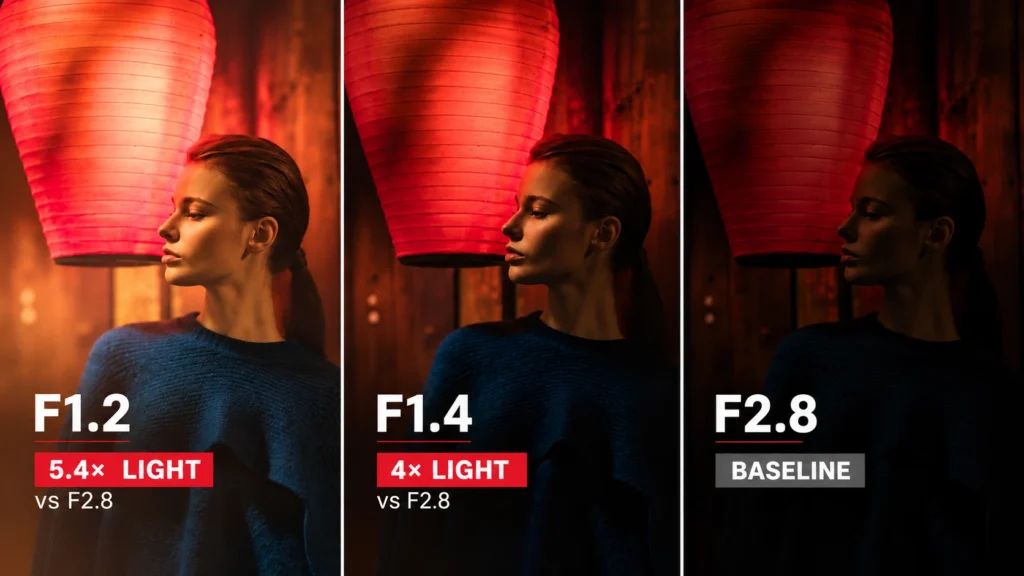
F1.4 gathers about four times as much light as F2.8. That answers how much brighter is f1.4 than f2.8 in one line.
The difference between these apertures is not evenly spaced. Each stop doubles or halves the light reaching your sensor. Here is the exact f1.2 vs f2.8 and f1.4 vs f2.8 breakdown:
| Aperture | Compared with F2.8 | What It Means |
|---|---|---|
| F1.2 | About 2.44 stops brighter | Roughly 5.4× as much light |
| F1.4 | Exactly 2 stops brighter | Roughly 4× as much light |
| F2.8 | Baseline | Less light, usually more depth of field |
A real exposure example makes this concrete. If F2.8 needs 1/125 sec at ISO 3200, F1.4 lets you shoot the same scene at roughly 1/125 sec and ISO 800. You could also keep the ISO and use a faster shutter instead. That flexibility is the entire point of a wider aperture.
F1.2 vs F1.4: Is the Difference Actually Noticeable?
The jump from F1.2 to F1.4 is small, only about 0.44 stop. Most photographers will not notice it in everyday shooting.
This is the honest answer to f1.2 vs f1.4 light difference. You gain a touch more light and a slightly shallower field. Background separation can look marginally stronger too. What you also gain is extra size, weight and cost, depending on the specific lenses compared.
Do not choose F1.2 purely because the number looks smaller. SIGMA’s own F1.2 lenses are built around more than raw brightness. The SIGMA 50mm F1.2 DG DN | Art focuses heavily on sharpness at maximum aperture, alongside smooth bokeh rendering. Lens design matters as much as the number on the barrel.
F1.4 vs F2.8: Where Is the Biggest Real-World Difference?
F1.4 is a full two stops faster than F2.8, and that gap shows up everywhere you shoot.
Is f1.4 better than f2.8? For low light and background blur, yes. For depth of field control and zoom flexibility, F2.8 has the edge. Here is where each one actually wins.
- Low light: In f1.4 vs f2.8 low light situations, F1.4 buys you a faster shutter or a lower ISO, often both at once.
- Background separation: At the same focal length and distance, F1.4 produces a noticeably shallower background than F2.8.
- Flexibility: F2.8 zooms let you reframe instantly without changing lenses, which matters at fast-moving events.
This trade-off, not the aperture number alone, is the real buying decision most people face.
Which Aperture Gives More Background Blur?
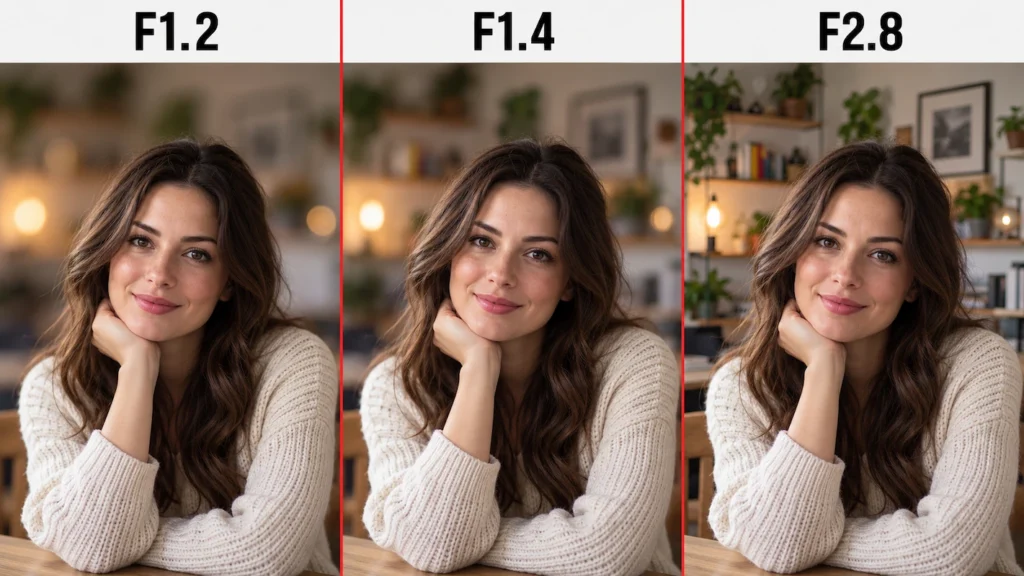
Background blur depends on more than aperture alone. Focal length, subject distance and sensor size all play a part.
At the same framing and distance, a wider aperture does reduce depth of field. But it is not the only variable. A longer lens or a closer subject can blur a background even at F2.8. This is why comparing f1.2 vs f1.4 bokeh side by side without matching distances is misleading.
In practical terms, expect this pattern:
- F1.2 delivers the strongest possible subject separation
- F1.4 comes very close, with slightly less isolation
- F2.8 still produces attractive blur with the right focal length
Is F1.2 or F1.4 Better for Low-Light Photography?
Both apertures outperform F2.8 in dim conditions, but F1.2 pulls in marginally more light.
This matters for real Pakistani shooting scenarios. Indoor wedding halls, Mehndi and Walima receptions, dim restaurants and night street scenes all push cameras to their limits. A wider aperture lets you hold a faster shutter, drop your ISO, or balance both.
It will not eliminate noise entirely, and no lens can promise that. What it does is give you more room to work with before image quality suffers. For available-light portraits after sunset, that margin often decides whether a shot is usable.
F1.2 vs F1.4 vs F2.8 for Portrait Photography
For most portrait work, F1.4 hits the sweet spot between blur, light and practicality.
That said, the best aperture for portraits depends on your subject count and shooting style. Use this table as a starting guide.
| Aperture | Best Suited When |
|---|---|
| F1.2 | Maximum subject separation and available-light portraits matter most |
| F1.4 | You want strong blur and low-light performance in a balanced prime |
| F2.8 | You need more depth of field, easier focus or zoom flexibility |
Very shallow depth of field is not always a bonus. At F1.2, keeping both eyes sharp on a close portrait gets harder. A single subject handles it well. A couple may need slight repositioning. Group shots are usually safer at F2.8 or narrower.
F1.4 Prime vs F2.8 Zoom: Which Is More Useful for Weddings?
For most Pakistani wedding shoots, carrying both is ideal, but if you must choose one, think about pace.
Choosing between a prime vs f2.8 zoom setup for f1.4 or f2.8 for wedding photography comes down to how the event moves.
Pick the F1.4 prime when:
- Low light indoors matters most
- Portraits and couple shots are the priority
- You are comfortable swapping lenses between segments
Pick the F2.8 zoom when:
- Moments happen fast, like Baraat entrances
- You need multiple focal lengths without lens changes
- Group photos are a big part of the coverage
Mehndi, Baraat and Walima each demand different pacing, which is exactly why many working photographers carry both.
Does a Wider Aperture Mean a Better or Sharper Lens?
Sharpness, autofocus speed, contrast, distortion control and flare resistance all depend on optical design, not the f-number alone. SIGMA’s F1.2 lenses illustrate this well. The 50mm F1.2 DG DN | Art was engineered specifically for high resolution at its widest setting, because a bright aperture alone does not guarantee it. The newly announced 85mm F1.2 DG | Art makes the same point at a different focal length, built for uncompromising sharpness and bokeh in a notably compact, lightweight body for an F1.2 lens. Never assume F2.8 is automatically sharper than F1.4 either. Performance varies lens by lens.
When Is F2.8 Actually the Better Choice?
F2.8 is often the smarter pick for anyone who needs one lens to cover many situations.
It suits events, group portraits, travel and video work well. It also helps when subjects move across varying distances during a single shoot. A constant F2.8 zoom, like the Sigma 24-70mm F2.8 DG DN II Art, pairs solid background blur with genuine day-to-day versatility. This is not a downgrade. It is a different tool for a different job.
Which Aperture Should You Choose Based on What You Shoot?
Use this table as a practical starting point, not a fixed rule.
| Photography Type | Starting Recommendation | Why |
|---|---|---|
| Portraits | F1.4 | Strong separation with practical handling |
| Low-Light Portraits | F1.2 to F1.4 | More available light |
| Weddings & Events | F1.4 prime or F2.8 zoom | Balances light and flexibility |
| Travel | F2.8 | One lens can cover more scenes |
| Street Photography | F1.4 to F2.8 | Depends on available light and lens size |
| Group Portraits | F2.8 or narrower | More consistent depth of field |
| Night Photography | F1.2 to F1.4 | Greater light-gathering capability |
SIGMA F1.2, F1.4 and F2.8 Lens Examples
A few SIGMA lenses show exactly how these apertures translate into real gear.
F1.2
- Sigma 50mm F1.2 DG DN Art
- Sigma 35mm F1.2 DG DN Art
F1.4
- Sigma 85mm F1.4 DG DN Art
- Sigma 56mm F1.4 DC DN Contemporary
F2.8
- Sigma 28-70mm F2.8 DG DN Contemporary
- Sigma 24-70mm F2.8 DG DN II Art
Browse the full SIGMA lens range to compare specs side by side.
Choose F1.2 when maximum low-light performance and very shallow depth of field justify the extra cost.
Choose F1.4 for the strongest overall balance of light, blur and practicality.
Choose F2.8 when flexibility, zoom range and easier depth-of-field control matter more.
Is Paying More for F1.2 Worth It?
For most photographers, F1.4 offers a better balance of light, blur and everyday practicality.
So is f1.2 worth it? Consider it if available light shooting defines your work, you deliberately want ultra-shallow depth of field, and the size or cost trade-off does not bother you.
Is f1.4 worth it more often? Usually yes. It delivers excellent low light performance and strong portrait blur, without F1.2’s incremental premium.
Wondering whether a wide aperture lens is worth it at all for your work? If you shoot mostly outdoors in good light, F2.8 covers you comfortably. So should I buy a f1.4 or f2.8 lens instead of chasing F1.2? For zoom flexibility and group coverage, F2.8 remains the practical choice, and pairing it with a prime lens covers the gaps.
Frequently Asked Questions
How much brighter is F1.4 than F2.8?
F1.4 is exactly two stops brighter than F2.8. That means it gathers about four times as much light, giving you faster shutter speeds or lower ISO in the same conditions.
Is F1.2 much better than F1.4?
Not necessarily. The gap is only about 0.44 stop. Most photographers notice a marginal light and blur difference, but the extra size, weight and cost may not justify it for everyone.
Is F1.4 or F2.8 better for portraits?
It depends on your subject and setup. F1.4 gives stronger blur and low light performance for single subjects, while F2.8 offers more depth of field for couples and groups.
Is F2.8 enough for low-light photography?
Yes, F2.8 is enough for many low-light situations, especially paired with modern camera sensors, image stabilization, or a tripod. Genuinely dark scenes still benefit from F1.4’s two extra stops of light.
Do I need F1.2 for professional photography?
No. Professional results come from many apertures. Choose based on your subject, lighting and creative goals, not just the widest number available.
