
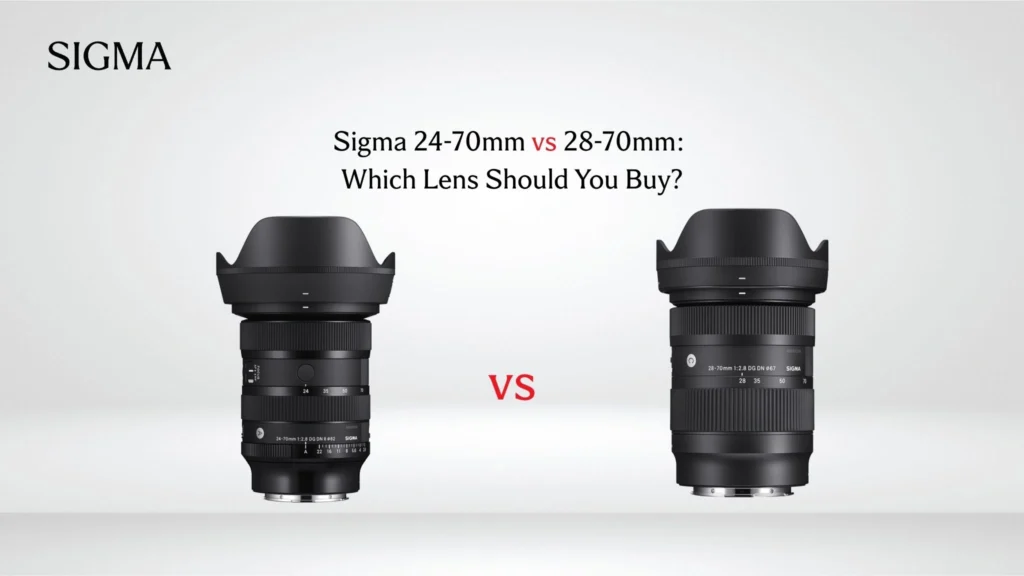
Comparing Sigma 24-70mm vs 28-70mm is essential if you shoot events, travel, or create content for a living. Zoom range is one of the first things you think about when picking a lens. Both the Sigma 24-70mm F2.8 and the Sigma 28-70mm F2.8 are a standard zoom lens choice that covers the focal range most photographers use every day. But they are built for different people, with different priorities and budgets.
This guide breaks down every key difference between the two. By the end, you will know exactly which one fits your shooting style.
Sigma Art vs Contemporary: What’s the Difference?
The Sigma Art Series is built for maximum optical performance and professional use. The Sigma Contemporary Series is built for everyday versatility at a lighter weight and lower price.
| Feature | Sigma 24-70mm Art | Sigma 28-70mm Contemporary |
| Build quality | Professional-grade | Lightweight, compact |
| Optical performance | Maximum sharpness | Very good, practical trade-offs |
| Weight | 735g | 470g |
| Weather sealing | Full dust and splash resistance | Basic splash resistance |
| Filter size | 82mm | 67mm |
| Gimbal friendly | Less ideal | More suitable |
| Best for | Professionals, demanding work | Enthusiasts, travel, everyday use |
If you are still deciding which philosophy fits your kit, check out our full guide on SIGMA Art vs Contemporary lenses.
Does 24mm vs 28mm Actually Matter?
Yes, it does. 24mm gives you a wider field of view, more scene coverage, and greater flexibility in tight spaces. 28mm is slightly narrower but noticeably lighter. The difference matters most in landscape, indoor, and video work where wide-angle framing is essential.
Here is how each scenario plays out across the three most common shooting situations.
Landscape and Travel Photography
At the wide end, 24mm gives you noticeably more scene coverage than 28mm. When you are standing in front of the Badshahi Mosque or trying to frame a mountain valley, that extra width helps. You can include more of the environment without stepping back. For serious travel photography lens use, 24mm is a real advantage. The 28-70mm can still handle travel well, but you will sometimes wish you had that wider view.
Indoor Photography and Events
Inside a wedding hall, a corporate event, or a small studio, 24mm gives you room to work. You can shoot full-room shots without distortion issues that come with ultra-wide lenses. The 28mm start still works in most indoor situations, but in tight venues, you will notice the difference.
Video and Content Creation
For video, the 24mm wide end gives you more compositional flexibility. Room tours, property walkthroughs, and talking-head shots with environmental context all benefit from a wider starting point. That said, if you mostly shoot in open spaces or never shoot architecture, 28mm is completely fine for video work.
Which Lens Produces Better Results in Real-World Shooting?
The 24-70mm Art produces better results overall. It leads in lens sharpness, autofocus performance, and low-light photography. The 28-70mm Contemporary holds its own for everyday shooting and delivers strong results across most real-world situations. The gap is most visible in demanding, professional conditions. The sections below cover sharpness, autofocus, and low-light performance in detail.
Sharpness and Bokeh
The 24-70mm Art is sharper, especially toward the edges of the frame. The lens sharpness difference is most visible in large prints and heavily cropped images, making it the better choice for product and editorial work.
Bokeh quality is similar on both lenses since they share the same F2.8 aperture. The Art produces slightly smoother background separation due to its more complex optical design. At portrait distances, both lenses deliver a natural, clean look that photographers and clients will be happy with.
Autofocus Performance
The 24-70mm Art has faster, more consistent autofocus performance. Sigma uses an HLA motor in the Art lens, which is noticeably quicker than the stepping motor in the 28-70mm. It locks on reliably in fast-moving scenes, events, and sports.
The 28-70mm Contemporary is accurate and handles everyday focus tasks well. It is not ideal for fast action, but for travel, portraits, and casual events, it performs without problems.
Low-Light Results
Both lenses open to F2.8, so light transmission is similar. The Art lens handles low-light photography better due to superior optical coatings and stronger control of flare and ghosting. In dim wedding venues or indoor stages, it keeps images cleaner. The 28-70mm performs well in low light too, but contrast can drop slightly when bright light sources are near the frame.
Is the Extra Size and Weight Worth It?
For professional and outdoor work, yes. For travel and gimbal shooting, the lighter 28-70mm Contemporary makes more practical sense. Lens weight, weather sealing, and filter size each play a role in that decision, as the comparison above shows.
Carrying the 24-70mm Art for six to eight hours on a wedding shoot adds up. Most photographers feel it in the neck and shoulders by day’s end. Despite that fatigue, the Art stays the better choice for weddings. Its wider reach and stronger sealing matter more than the extra grams on client work.
On a gimbal, the heavier barrel shifts the balance point, so riggers often add counterweight. The 28-70mm Contemporary skips that step at 470g. Its smaller 67mm filters also cost less to replace than the Art’s 82mm filters over time.
Which Lens Works Better for Content Creators?
The 24-70mm Art works best as a single content creator lens when a shoot moves between wide establishing shots and tighter product or interview framing. The 28-70mm Contemporary suits creators who shoot mostly one type of scene and want a lighter kit.
Here is how that workflow plays out across common content creation scenarios
Travel and Vlogging
Packing for a trip, the 28-70mm Contemporary fits into a smaller bag alongside a second lens, a mic, and batteries, which matters when every kilogram counts on a trip. Fewer lens swaps midway through a shoot day also means less time spent on lens caps and filter changes for travel content creators working solo.
YouTube and Commercial Content
In a studio setup where the camera stays on a tripod, lens swaps cost nothing extra in time, so the choice comes down to the shot itself rather than convenience. Many creators keep both lenses on hand and switch mid-session for talking-head segments versus product close-ups.
Gimbal and Run-and-Gun Shooting
The 28-70mm Contemporary is the winner here. Mounting the 28-70mm Contemporary as a vlogging lens on a gimbal takes less rebalancing time between battery swaps, since its lighter front element shifts the center of gravity less. That saves real time on run-and-gun shoots, where every setup delay risks a missed moment. Street content, documentary-style work, and event coverage all benefit from a lighter setup that you can move quickly without tiring out your wrists.
Sigma 24-70mm vs Tamron 28-75mm: Is the Sigma Worth It?
Many photographers compare the Sigma 24-70mm vs 28-70mm debate to the Tamron 28-75mm F2.8 as a third option. The Tamron 28-75mm is a popular lightweight zoom, but it competes more directly with the Sigma 28-70mm Contemporary in terms of size and pricing.
The Sigma 24-70mm Art outperforms the Tamron in sharpness, autofocus speed, and build quality. The Tamron is lighter and more affordable, but it falls short on optical consistency and long-term reliability. For photographers who want Sigma’s image quality without the Art-series price, the Sigma 28-70mm Contemporary is the better alternative to the Tamron, offering similar portability with stronger optical performance.
Buying through Sigma Pakistan also means full local warranty support, something grey-market Tamron units in Pakistan often lack.
Sigma 24-70mm Price vs 28-70mm Price in Pakistan
In Pakistan, the price difference between these two lenses is substantial.
- Sigma 24-70mm F2.8 DG DN II Art: PKR 308,000
- Sigma 28-70mm F2.8 DG DN Contemporary: PKR 245,000
This makes the 28-70mm Contemporary accessible for photographers who want F2.8 zoom performance without the full Art series price tag. Both lenses come in Sony E-mount and L-Mount, so your camera system won’t limit your choice between them.
Prices can shift with dollar rate fluctuations, so the figures above may vary slightly at the time of your purchase. For current, updated prices, check our online store at Sigma Pakistan. You can also visit our display center at Japan Street, Nisbat Road, Camera Market, Lahore. See and test both lenses in person before you buy.
Which Lens Should You Buy?
The right choice depends on how you shoot, not just what each lens offers on paper. Match your priorities below to find the better fit.
Choose the 24-70mm If…
- You are a working professional shooting wedding photography lens work, commercial assignments, or events
- You need the sharpest, most reliable results for client work
- You value weather sealing, faster autofocus, and optical quality above all else
- You work in tight indoor venues and need that 24mm wide-angle advantage
- You shoot on a gimbal occasionally, but your primary work is stills
Choose the 28-70mm If…
- You are a travel shooter, content creator, or enthusiast who wants F2.8 performance in a lighter package
- Your shooting style is casual to semi-professional
- You do not need the last five percent of optical performance
- You shoot primarily outdoors or in well-lit environments
- You are buying your first professional zoom and want to invest wisely without overspending
Final Thoughts
The Sigma 24-70mm vs 28-70mm decision comes down to how you shoot, not just which lens has better specs. The Art lens delivers professional-grade sharpness, faster autofocus, and stronger weather sealing. That combination makes it the better all-in-one choice for weddings, commercial work, and versatile content creation. The Contemporary lens trades some of that performance for a lighter build and a more accessible price. That trade-off makes it a smart pick for travel, vlogging, and gimbal-based work.
Neither lens is a compromise if chosen correctly. Pick the one that fits how you actually shoot, not just the one with the better specs on paper.
Both lenses are available through Sigma Pakistan across Pakistan. Reach out to our team for personalized guidance based on your camera system and shooting style.
Common Questions About Sigma Lenses
Is 24mm noticeably wider than 28mm?
Yes, 24mm is noticeably wider than 28mm. This 4mm gap increases the field of view enough to capture more background, making 24mm better suited for landscapes, architecture, and tight indoor spaces compared to 28mm.
Which Sigma zoom lens offers better value in Pakistan?
The Sigma 28-70mm F2.8 DG DN Contemporary offers better value in Pakistan, priced at PKR 245,000. It delivers professional-grade sharpness and a bright aperture at a lower cost than Sigma’s premium Art-series zoom alternatives.
Is the 4mm difference between 24mm and 28mm significant?
Yes, the 4mm difference is significant in wide-angle photography. It noticeably changes framing, perspective, and how much background fits into the shot, making 24mm feel distinctly wider than 28mm in real-world use.
What is the difference between Sigma 24-70 and Sigma 28-70?
The difference is between weight, size, price, and build quality. The Sigma 24-70mm F2.8 DG DN II Art weighs 735g with a robust, weather-sealed build, a heavy-duty workhorse lens, priced PKR 308,000. The Sigma 28-70mm F2.8 DG DN Contemporary weighs 470g, a lighter, compact travel companion, priced PKR 245,000.
Which lens is better, 24-70 or 28-70?
The Sigma 24-70mm F2.8 DG DN II Art suits professionals needing a wider range and premium optics. The Sigma 28-70mm F2.8 DG DN Contemporary suits photographers wanting strong performance at a more affordable price point.
