
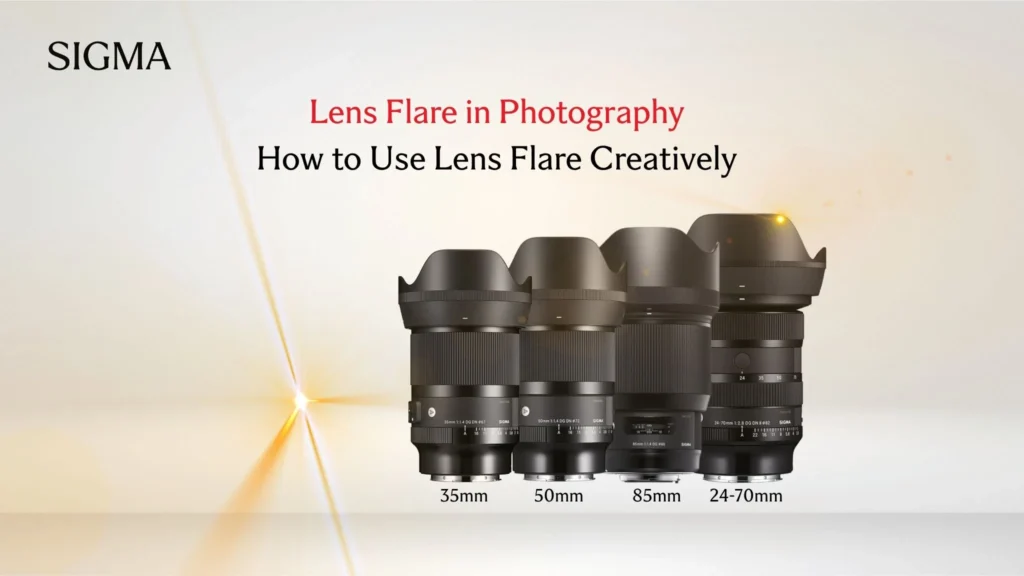
You’ve seen it in movies. That warm, hazy glow stretching across the frame. That soft burst of light bleeding into a portrait. It feels cinematic, emotional, and alive. That’s lens flare and it’s one of the most misunderstood elements in photography. Some photographers spend years trying to avoid it. Meanwhile, others chase it deliberately. The truth? Camera lens flare is neither good nor bad. It’s a creative tool. So, when used correctly with intention, it transforms an ordinary photo into something that genuinely feels warm and human.
In fact, in this guide, you’ll learn exactly what causes this effect, how different lenses handle this optical phenomenon, and how to use it creatively across portraits, landscapes, and cinematic shots. Whether you’re a beginner or a working professional, this 2026 guide gives you everything you need to understand and control lens flare confidently.
What Is Lens Flare in Photography?
Lens flare in photography is a visual effect that occurs when bright light such as the sun or artificial lighting enters a camera lens and scatters inside it. This creates artifacts like haze, streaks, or circular spots in an image. While often considered a flaw, this optical flare effect can also be used creatively to add mood, warmth, or cinematic style to photos.
It typically happens when shooting directly toward a strong light source without proper lens protection. Photographers can reduce it using lens hoods, adjusting angles, or using high-quality coated lenses. Conversely, some intentionally include this light scattering effect to enhance storytelling and create visually striking compositions in portrait, landscape, and street photography. Moreover, this creative use adds depth and emotional impact to the final image.
What Causes Lens Flare in Photos
Lens flare doesn’t happen randomly. Specific conditions trigger it every time. Therefore, understanding these causes gives you full creative control whether you’re trying to create it or avoid it completely.
Light Source Angle and Position
The angle between your lens and the light source is the single biggest factor in lens flare. When a bright light source enters your frame the sun, a street lamp, or a studio strobe stray light hits the lens at an unexpected angle. That angle is one the lens simply wasn’t designed to handle cleanly. This off-axis light bounces between internal elements, creating visible flare artifacts across your image. Shooting directly into the sun produces the strongest flare. In addition, moving the light source slightly to the frame edge creates a more controlled, cinematic effect. Consequently, even a small position shift dramatically changes how much flare appears.
Lens Elements and Coating Quality
Modern lenses contain multiple glass elements, sometimes 10 to 20 individual pieces. Every time light passes through an element, a small percentage reflects internally rather than transmitting cleanly forward. These internal reflections build up and scatter as camera lens flare. The more glass elements a lens has, the more opportunity for internal reflections to occur. Lens coatings exist specifically to reduce this problem. High-quality anti-reflective coatings like Sigma’s Super Multi-Layer Coating minimize internal reflections and reduce unwanted lens ghosting.
However, no coating eliminates flare completely. Budget lenses usually have minimal coatings. Because of this, they produce far more uncontrolled optical distortion from light compared to premium lenses, a difference you’ll notice immediately in the field.
Camera Settings Impact
Your camera settings directly influence how lens flare appears. Aperture is the most important variable. Smaller apertures f/8, f/11, f/16 produce sharp starburst flare effects. Wider apertures f/1.4 to f/2.8 create softer, more diffused glows. Shutter speed matters too. Slower speeds allow more light to hit the sensor, intensifying flare in long-exposure shots. Similarly, higher ISO settings can amplify flare artifacts alongside noise. Understanding these relationships gives you full creative control. Simply changing your aperture from f/2.8 to f/11 transforms a soft glow into a sharp, dramatic sunstar without touching your composition at all.
Types of Lens Flare in Photography
Not all flares look the same. The type of flare you get depends on your lens, aperture, and light source. To clarify, here are the two main types every photographer should recognise and understand.
Veiling Flare (Soft Glow Effect)
Veiling flare is the soft, hazy kind. It washes across your image like a warm, diffused glow reducing contrast, lifting shadows, and giving the frame a dreamy, halo effect around your subject. It’s common when shooting toward a low sun or a large, bright window. In some shots, that contrast loss looks beautiful especially in portrait and lifestyle photography where a soft, ethereal mood suits the subject. Alternatively, a lens hood blocks much of the off-axis light responsible for it. Or embrace it intentionally, position your subject within the glow and let the warmth wrap around them naturally. Furthermore, this effect can enhance mood in storytelling shots.
Ghosting Flare (Circles and Shapes)
Ghosting flare appears as distinct circles, hexagons, or geometric shapes lined up across the frame typically opposite your light source. These streaks of light are reflections of your lens aperture blades and add raw, authentic energy to your composition. A six-blade lens produces hexagonal ghosts. A nine-blade lens produces rounder, softer circles. Ghosting is highly lens-specific. Coating quality, element spacing, and blade count all determine how defined the ghost shapes appear. Some photographers love this graphic quality; it adds raw, authentic energy to lens flare photography. Indeed, used deliberately in environmental portraits or concert photography, ghosting flare creates visual layers that feel immediate, real, and cinematic.
Is Lens Flare Good or Bad in Photography?
This is one of the most common questions photographers ask and the honest answer is: it depends entirely on your intent. Technically, lens flare reduces sharpness, lowers contrast, and can obscure important detail. In product photography, architecture, or scientific imaging, flare is always unwanted. Clean, accurate rendering matters more than atmosphere. But, in portrait, lifestyle, wedding, and cinematic photography, flare tells a different story. It adds warmth, spontaneity, and a sense of real light hitting a real moment. Some of the most memorable photographs ever taken include intentional flare.
The key distinction is control. In other words, accidental, unnoticed flare usually weakens an image. Deliberate, well-placed flare strengthens it. Understanding the difference and developing the skill to choose is what separates photographers who react to light from those who truly direct it. Flare is a tool. Use it with intention.
How to Create Lens Flare Intentionally
Creating lens flare on purpose is easier than most photographers think. Essentially, it comes down to four consistent techniques that work across different lenses, locations, and lighting conditions.
Shoot Toward the Light Source
The most direct way to create lens flare is pointing your lens toward a bright light source. Position the sun, a street lamp, or a window at the frame edge not behind you. When the light sits just inside or outside the frame boundary, this natural light effect appears most naturally. Dead center placement creates an overpowering wash. Edge placement gives controlled, cinematic results. Always remove your lens hood first. Lens hoods block off-axis light, the exact light you need for intentional flare. This single step makes the biggest immediate difference when creating a deliberate lens flare effect in the fiel
Use Wide Aperture Settings
Wide aperture settings between f/1.4 and f/2.8 produce the softest, most organic-looking lens flare. Scattered light spreads smoothly across the frame without forming harsh geometric shapes. This soft flare wraps warmth around your subject without distracting from expression or detail. The bokeh and light effects at wide apertures combine naturally with this cinematic lighting effect for a film-like rendering. Sigma’s fast prime lenses the 35mm f/1.4, 50mm f/1.4, and 85mm f/1.4 Art are perfectly suited for this technique. Their coating quality produces flare that feels controlled and intentional. Wide aperture flare on a quality prime has a character zoom lenses simply can’t replicate. For instance, portrait photographers rely heavily on this look.
Adjust Camera Angle Slightly
Small angle adjustments create dramatic differences in how this effect appears. Moving your camera just a few centimetres left, right, up, or down shifts flare intensity instantly. This micro-adjustment technique gives you real-time creative control without changing your composition significantly. Rock your camera gently while watching through the viewfinder. See how the flare shifts, grows, fades, or changes shape with each small movement. Experienced photographers use this constantly during golden-hour shoots. It’s how they find that perfect balance flare present enough to add atmosphere, controlled enough to keep the subject clear.
Shoot During Golden Hour
Golden hour the first hour after sunrise and last hour before sunset produces the warmest, most flattering light for intentional lens flare. The sun sits low on the horizon, creating soft rays that interact with your lens at a shallow angle. The result is warm, amber-toned flare rather than harsh white blowouts. Golden hour flare works beautifully across portraits, landscapes, street photography, and weddings. Warm tones complement skin naturally and add timeless emotional quality to every image. Plan your outdoor shoots around golden hour whenever intentional flare is part of your creative vision. Hence, timing becomes a critical factor.
Best Camera Settings for Lens Flare Photography
The right settings give you consistent, controlled flare results every time. Start here and adjust based on your specific light and lens:
- Aperture: Use f/1.4–f/2.8 for soft, diffused flare. Use f/8–f/16 for sharp sunstar effects around point light sources.
- Shutter Speed: Use 1/500s–1/1000s in bright sunlight to retain exposure control while shooting toward the light.
- ISO: Keep ISO at 100–200 outdoors. Low ISO preserves clean highlights and prevents flare from washing out detail.
- White Balance: Set to Daylight (5500K) or Shade (7000K) during golden hour to retain warm flare tones accurately.
- Focus Mode: Use single-point manual or autofocus. Flare can confuse contrast-detection autofocus systems in bright conditions.
- Metering Mode: Use spot metering on your subject, not the bright light source, to maintain correct subject exposure.
- Lens Hood: Remove it intentionally when creating flare. Keep it on when you want clean, flare-free images.
Creative Ways to Use Lens Flare in Photography
Lens flare isn’t limited to one style or subject. When used thoughtfully, it elevates images across multiple photography genres. Here are three creative applications that working photographers use regularly.
Portrait Photography with Lens Flare
In portrait photography, a natural light flare adds warmth, softness, and a glowing atmosphere that studio lighting rarely replicates. Position your subject backlit with the light source just outside the frame edge. The flare wraps around the subject’s outline, creating a luminous, warm rim. Combined with a wide aperture on a fast prime lens, you get beautiful background blur and a golden atmospheric quality. This technique works especially well during engagement shoots and outdoor sessions. It looks less like a posed photograph and more like a genuinely captured moment
Landscape Photography with Sunlight
Intentional sun flare effect transforms a straightforward landscape into something cinematic and emotionally charged. Position the sun at the corner of your frame during golden hour. Shoot at f/11 for a sharp, defined sunstar effect. The starburst rays add visual energy and draw the eye naturally through the composition. For wide shots, the Sigma 14mm or 24mm Art handles sunstar flare with exceptional sharpness and minimal ghosting. The controlled optical design adds drama without destroying edge sharpness or shadow detail across the scene.
Cinematic and Storytelling Shots
Film directors have used lens flare deliberately for decades. It signals authenticity to the feeling that a camera was present in a real moment. In photography, flare makes storytelling images feel documentary, immediate, and human. For street photography and editorial work, subtle lens flare effect in the corner adds atmosphere without overwhelming the subject. Shoot in mixed urban lighting neon signs, shop windows, street lamps for unconventional, contemporary flare effects. Each light source produces a different flare character, giving every image its own distinct visual personality.
Natural vs Artificial Lens Flare (Photoshop & Overlays)
Not every flare needs to be captured on camera. Many photographers add or enhance flare in post-production. Here’s a clear comparison to help you decide which approach suits your workflow.
| Feature | Natural Lens Flare | Lens Flare Photoshop / Lens Flare Overlay |
| Source | Captured in camera optically | Added in post-production digitally |
| Authenticity | Completely organic and real | Can look artificial if overused |
| Control | Limited — adjusted by angle and settings | Full control over position, opacity, colour |
| Consistency | Varies shot to shot | Identical across multiple images |
| Quality | Unique to each lens | Depends on overlay or lens flare filter quality |
| Best For | Portraits, landscapes, weddings | Composites, commercial edits, batch workflows |
| Learning Curve | Requires field practice | Requires post-production skill |
| Cost | Free — use your existing lens | Requires software or premium overlay packs |
| Feel | Raw, alive, photographic | Polished, controlled, sometimes less believable |
When to Use Lens Flare
Use natural camera lens flare when authenticity matters most. Portraits, weddings, lifestyle, and documentary work all benefit from real, organic flare captured in camera. Use lens flare photoshop techniques or lens flare overlay packs for composite images, commercial projects, or when you missed the flare on location. Neither approach is wrong. Many professionals combine both capturing natural flare in camera and refining it subtly in post. The important thing is simple: flare should serve the image. If it feels forced or distracting, it weakens the photo. Let the story guide your decision every time.
Common Mistakes When Shooting Lens Flare
Avoiding these common errors will immediately improve the quality and consistency of your flare shots:
- Leaving the lens hood on: The lens hood blocks off-axis light entirely. Always remove it when shooting an intentional flare.
- Placing the light source dead center: Central flare creates an overwhelming wash. Keep the light source at the frame edge for more controlled, balanced results.
- Using the wrong aperture: f/1.4 produces soft glow. f/11 produces sunstars. Using the wrong aperture for the intended effect produces disappointing results.
- Ignoring subject exposure: Metering off the bright sky underexposes your subject completely. Always spot-meter on your subject’s face or key element.
- Shooting at midday: Harsh overhead sun produces unflattering, blown-out flare. Golden hour produces warm, manageable, beautiful flare every time.
- Overusing flare in a series: One or two flare shots in a set feel intentional. Ten consecutive flare shots feel repetitive and unplanned.
- Dirty lens elements: Dust, smudges, and fingerprints on your lens dramatically worsen flare quality. Always clean your lens before shooting toward bright light sources.
Sigma Lens Performance in Handling Lens Flare
Sigma lenses strike a deliberate balance between flare control and creative flexibility. The Sigma Art series features Super Multi-Layer Coating, an advanced anti-reflective treatment on every glass element. This coating significantly reduces unwanted ghosting and veiling flare in standard shooting conditions. At the same time, Sigma’s optical design still allows beautiful, intentional flare when you want it. The 35mm f/1.4 Art, 50mm f/1.4 Art, and 85mm f/1.4 Art produce warm, characterful golden-hour flare. Unlike budget lenses, harsh uncontrolled artifacts stay minimal.
For landscape photographers, the Sigma 14-24mm f/2.8 Art is exceptional. It delivers sharp, clean sunstar flare at f/11 with minimal ghosting across the frame. Whether you’re avoiding flare or chasing it creatively, Sigma lenses give you the optical consistency and confidence to execute your vision every single shoot.
Final Thoughts
Lens flare is one of photography’s most powerful and most misunderstood creative tools. It’s not a flaw to always fix. It’s not a trend to blindly chase. Used with intention, it adds warmth, atmosphere, and genuine emotion to your images. Understanding what causes flare gives you real control. Knowing how different lenses handle it helps you choose wisely. Practising golden-hour timing, angle adjustments, and aperture choices builds natural creative instinct over time. The best photographers don’t fight their equipment. They understand it deeply and use it creatively.
Sigma lenses built with precision coating and exceptional optical quality give you a reliable foundation. Explore lens flare confidently on your own terms. Go outside. Find good light. Let the flare work for you. In short, mastery comes with practice and intention.
Frequently Asked Questions
What is lens flare in photography?
Lens flare is a visual effect caused when bright light enters a camera lens and scatters internally. It appears as haze, streaks, or circular spots in photos. This usually happens when shooting toward the sun or strong light sources, thus affecting contrast, clarity, and overall image quality.
Is lens flare good or bad?
Lens flare can be both good and bad depending on intent. It may reduce sharpness and contrast, which is undesirable in technical photography. On the other hand, many photographers use it creatively to add warmth, depth, and a cinematic feel, making images more artistic and visually engaging.
How do you create lens flare in photos?
To create lens flare, shoot directly toward a strong light source like the sun or bright artificial lights. Use wide apertures and slightly adjust your angle until flare appears. Additionally, removing a lens hood or partially blocking light with objects can also help achieve natural, creative flare effects.
How do you avoid lens flare?
To avoid lens flare, use a lens hood to block stray light and change your shooting angle. Keep the light source outside the frame whenever possible. Clean your lens regularly and use high-quality lenses with anti-reflective coatings to minimize internal reflections and maintain image clarity.
Which lens is best for lens flare photography?
Prime lenses with wide apertures are often best for lens flare photography because they produce cleaner, more controlled flare effects. Vintage or uncoated lenses can create stronger, artistic flares. Modern lenses with coatings reduce flare, but some models still allow subtle, aesthetically pleasing results.
