
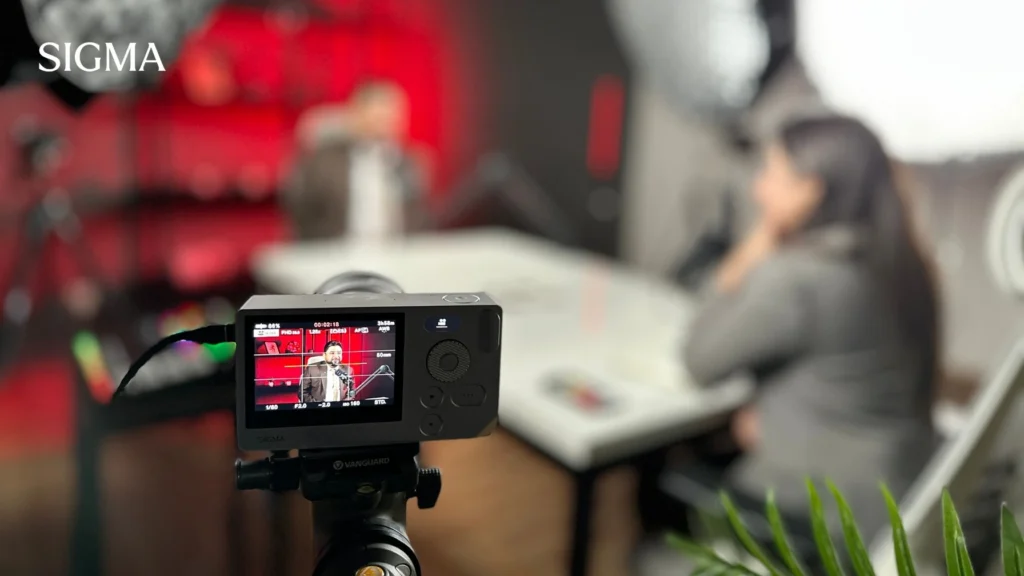
There is no single right camera distance for talking head video. The right distance depends on your focal length, sensor size and framing. Wider lenses let you work closer, while longer lenses need more room. For a natural-looking face, avoid placing the camera closer than you need. Instead, pick a focal length that gives your framing from the distance your room allows.
This guide helps you fix a distorted face, check your room depth and match a lens to your space. It suits YouTubers, podcasters and teachers recording from home studios and small offices across Pakistan.
Quick answer
For talking-head videos, the right camera distance depends on focal length, sensor size and framing. Wider lenses work closer; longer lenses need more room. Move the camera back whenever your face starts looking stretched or unnatural.
Is There a Perfect Camera Distance for Talking-Head Videos?
No, there is no perfect distance that works for every setup. A fixed rule like 3 feet, 5 feet or 2 metres ignores your lens and your room.
Your ideal talking head camera distance changes with:
- Focal length of your lens
- Full frame or APS-C sensor
- Chest-up or head-and-shoulders framing
- Desk setup or standing setup
- Vertical or horizontal video
- How much background you want to show
The same logic applies to camera distance for YouTube videos and camera distance for podcast video. Two creators with the same camera can need very different distances. Start with your framing and room, then choose the lens that fits both.
What Actually Changes When You Move the Camera Closer or Farther Away?
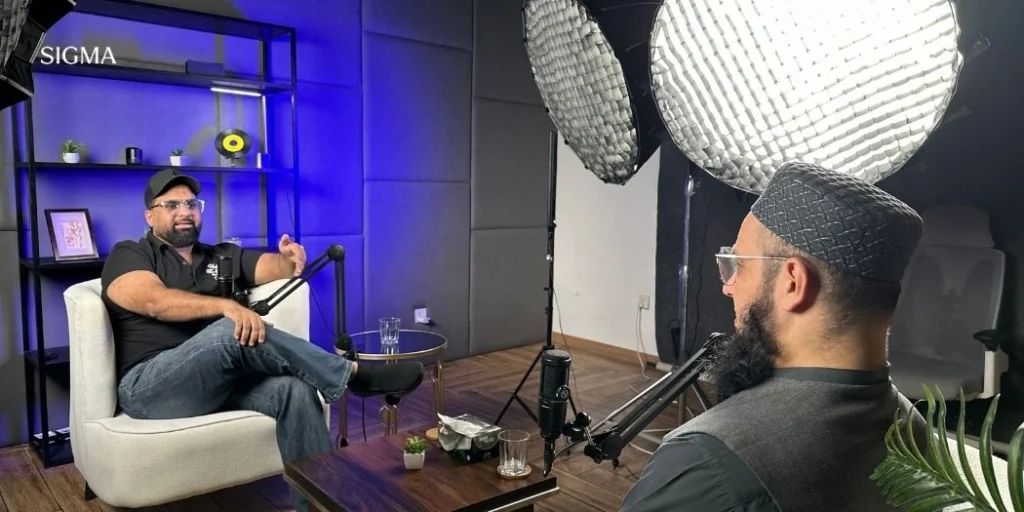
Moving the camera changes perspective, which is how your facial features look in relation to each other. Perspective comes from camera position, not from the focal length itself.
If you stay in one spot and only change focal length, you simply change the framing. Perspective changes when you move the camera to keep the same framing. So a wide lens does not distort a face on its own. It pushes you closer to fill the frame, and that short distance exaggerates your features.
Move the camera closer
- Nose and forehead appear larger
- Background looks smaller and farther away
- You need a wider lens
- Useful when room depth is limited
Move the camera farther away
- Facial features look more balanced
- Background appears larger and closer
- You need a longer focal length
- Needs more room depth
How Far Should the Camera Be for 24mm, 35mm and 50mm?
Each focal length suits a different room size, so there is no single distance for each lens. Longer focal lengths need the camera farther back for the same framing.
24mm
Best for: Wide or environmental talking heads
Small-room friendly
35mm
Best for: Balanced chest-up or desk shots
Moderate room depth
50mm
Best for: Tighter and flattering framing
Needs more room
70mm+
Best for: Close-up or second-camera angles
Studio or deep room
Most creators settle between 35mm and 50mm equivalent for medium shots. That range is often called the best focal length for talking head video because faces look natural. Treat talking head focal length and distance as one decision, since changing one forces a change in the other.
As a rough full frame example, a horizontal chest-up shot needs about 1 metre at 35mm. The same frame needs about 1.4 metres at 50mm. Treat these as the starting best camera distance for 35mm lens setups. The same goes for the best camera distance for a 50mm lens. Your exact framing will shift both slightly.
35mm vs 50mm: How Much More Camera Distance Do You Need?
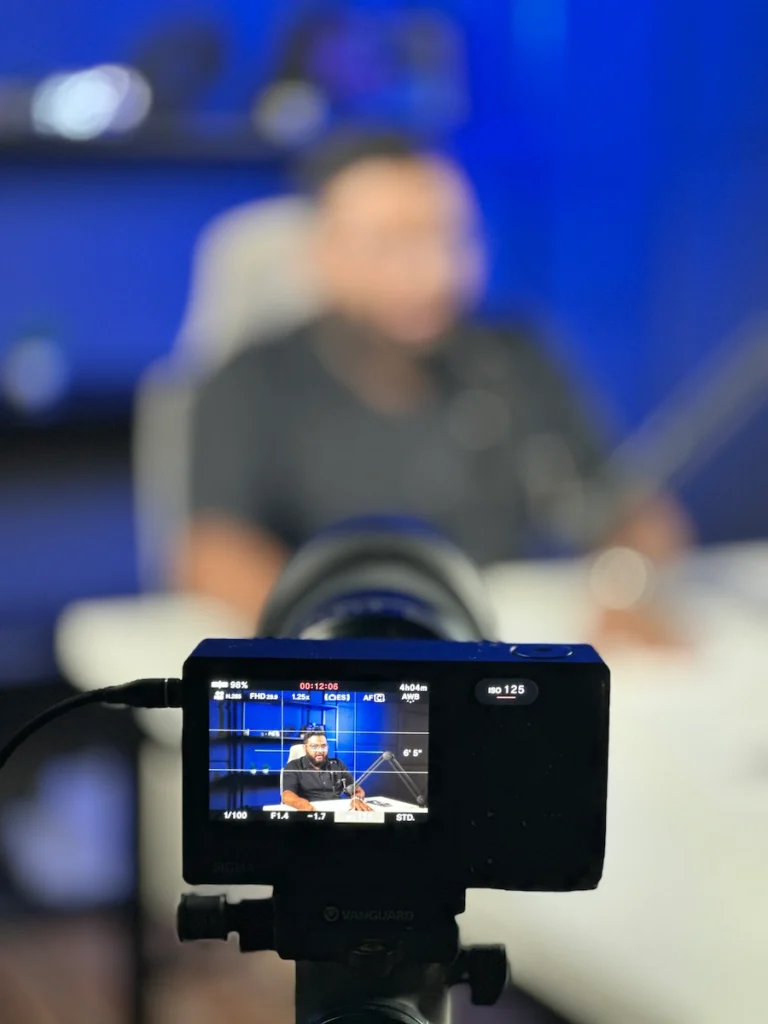
For the same framing, a 50mm lens needs the camera about 1.4 times farther away than a 35mm lens. That extra depth is the main difference in any 35mm vs 50mm talking head decision.
35mm
Room depth: Works in limited space
Background: Shows more desk and room context
Framing: Relaxed chest-up or desk shot
50mm
Room depth: Needs a deeper room
Background: Shows less and looks cleaner
Framing: Tighter, more personal frame
Choose 35mm when your room is shallow or your desk and shelves are part of the look. A shorter 35mm talking head distance also keeps the camera within easy reach while recording.
Choose 50mm when you have room to step back and want a tighter frame. A longer 50mm talking head distance gives a flattering look but eats into small rooms quickly. On a crop camera, a 50mm lens can need 5 to 6 feet for a wider frame.
How Close Is Too Close for a Talking-Head Video?
The camera is too close when your face stops looking like it does in person. The quickest fix is to move the camera back and use a slightly longer focal length.
Common signs of camera too close face distortion include:
- Your nose looks unusually large
- Your ears seem pushed far back
- Your forehead or chin looks stretched
- The shot feels like a phone selfie
- Viewers say you look different on camera
To fix it:
- Move the camera farther back
- Switch to a slightly longer focal length
- Reframe to keep your head and shoulders in view
People searching how far should camera be for headshot video usually want a tight frame. For tight headshots, a longer lens from farther back usually looks more natural than a wide lens up close.
APS-C vs Full Frame: Does Sensor Size Change Camera Distance?
Yes, sensor size changes camera distance indirectly because it changes the field of view. The same focal length looks tighter on APS-C and wider on full frame.
This means your APS-C talking head distance needs a shorter lens for a similar frame. Your full frame talking head distance works with a longer lens from the same spot. Most APS-C cameras from Sony, Nikon and Fujifilm use a 1.5x crop factor. Canon APS-C cameras use about 1.6x.
On a 1.5x crop camera, common APS-C lenses behave like this:
APS-C equivalent view on a 1.5× crop body
≈ 24mm
≈ 35mm
≈ 45mm
Canon APS-C uses about a 1.6× crop, so the same lenses appear slightly tighter.
On Canon APS-C, the same lenses look slightly tighter. A 30mm lens gives about 48mm equivalent there.
Best Camera Distance for a Small Room or Bedroom Studio
In a small room, decide your framing first, then measure the usable distance and pick the lens that fits. Many Pakistani creators record in converted bedrooms, where a bed or wardrobe limits depth. Searches like camera distance small room video usually come from this exact problem.
Decide Your Framing
Choose your shot before moving any furniture. Common options include:
- Head and shoulders
- Chest-up
- Waist-up
- Presenter with desk visible
Measure the Usable Camera Distance
Do not measure wall to wall. Measure the real space from the lens to your face.
Account for:
- Desk depth
- Tripod legs and footprint
- Gap between you and the back wall
- Monitor or teleprompter
- Space you need behind the camera
Choose the Focal Length That Fits
If you cannot move back, use a wider lens and frame a little looser. If you have more space, 35mm or 50mm equivalent framing becomes much easier. Let the room decide the lens, not the other way round.
How Far Should the Subject Be From the Background?
Keep as much space as possible between you and the background, ideally a few feet or more. This gap is separate from camera-to-subject distance, and it matters just as much.
More subject-to-background distance gives you:
- Cleaner separation between you and the wall
- More depth in the frame
- Softer background blur
- Fewer shadows falling on the wall
Before opening your aperture wider, try moving yourself away from the background first. This often gives a cleaner look without a thin focus zone.
Where Should the Camera Be Positioned Vertically?
Place the camera at eye level or slightly above for most talking-head videos. This gives a natural eyeline and a neutral, flattering perspective.
The right camera position for talking head video helps you:
- Keep a natural eyeline with viewers
- Avoid looking up the nose from a low angle
- Hold steady eye contact with the lens
- Keep your face shape neutral
A camera placed too low on a desk is one of the most common setup problems. Raise the tripod or use a small stand until the lens meets your eyes.
Camera Distance by Talking-Head Framing
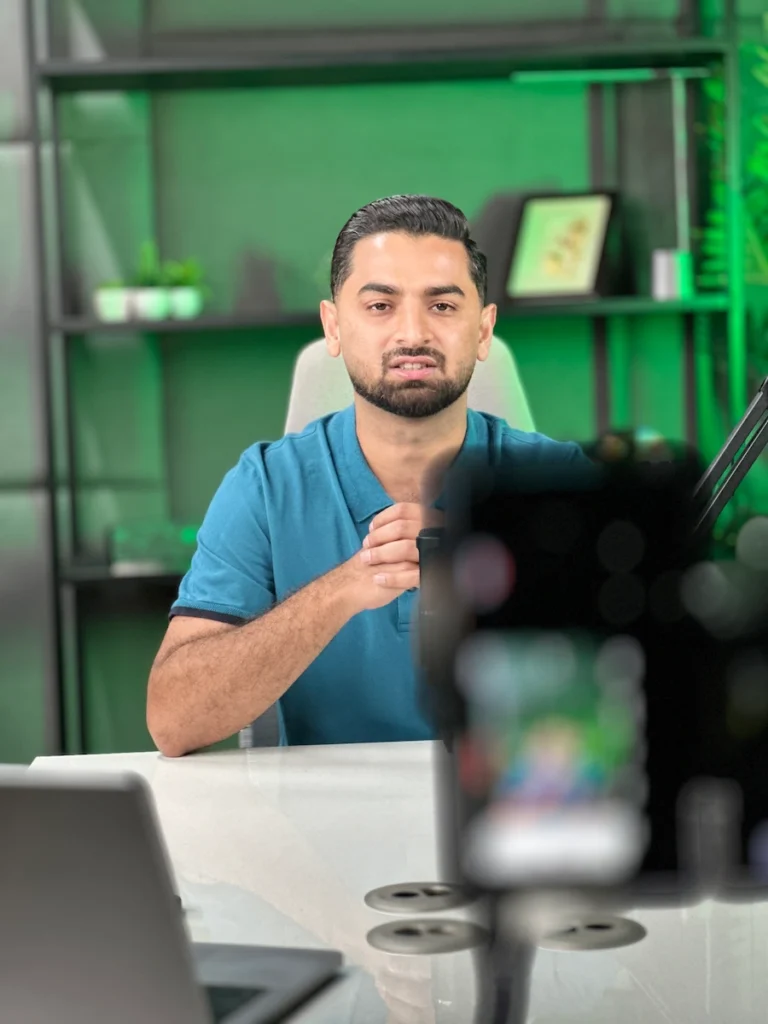
Tighter framing needs more distance and a longer lens, while wider framing works closer with a wider lens. Use this table as a quick guide to camera distance for talking head video by shot type.
| Framing | Camera Position Strategy | Lens Tendency (Full Frame) |
|---|---|---|
| Head and shoulders | More distance for natural face perspective | 35–85mm |
| Chest-up | Balanced distance | 35–50mm |
| Waist-up | Closer or wider setup may be needed | 24–35mm |
| Presenter with desk | Wider field of view | 24–35mm |
| Presenter with room | Wide setup | 20–35mm |
These are starting ranges, not fixed rules. Test them in your own room before you settle on a setup.
How to Find the Right Distance Without Calculating Anything
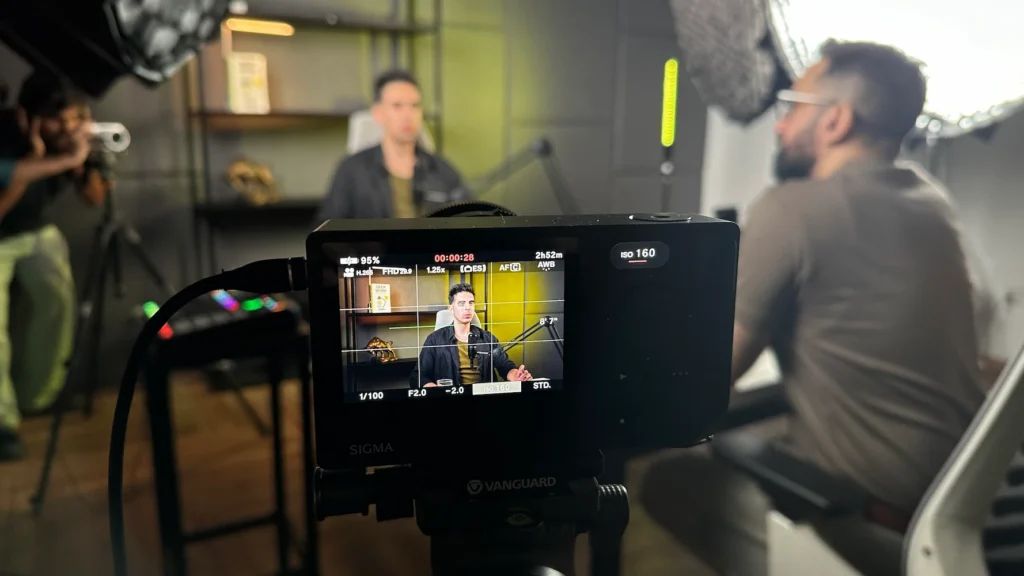
The easiest way is to test framing in your real room with the zoom lens you already own. This shows the focal length your space actually needs.
- Put the camera as far back as the room comfortably allows.
- Set the camera at eye level.
- Start with your existing zoom lens.
- Frame yourself chest-up or as you prefer.
- Check your face for any stretched features.
- If the lens is too wide and you are too close, move back.
- Note the focal length that looks right.
- Use that number before buying a prime lens.
This simple test settles most 35mm vs 50mm video debates before you spend any money.
Which SIGMA Focal Lengths Work for Talking-Head Setups?
| Setup | SIGMA Lens | Why It Fits |
|---|---|---|
| Small APS-C room | 16mm F1.4 DC DN | Wide frame from short distances |
| Small APS-C room | 18–50mm F2.8 DC DN | Flexible zoom to test framing |
| Balanced APS-C setup | 23mm F1.4 DC DN | Natural 35mm-style chest-up view |
| Balanced APS-C setup | 30mm F1.4 DC DN | Tighter frame in medium rooms |
| Tight APS-C headshot | 56mm F1.4 DC DN | Portrait look in deeper rooms |
| Full-frame setup | 35mm F1.4 DG DN | Balanced frame for most home studios |
| Full-frame setup | 50mm F1.4 DG DN | Flattering tighter frame in deeper rooms |
The right SIGMA lens depends on your room depth and sensor size, not just aperture or reputation. Match the focal length your test showed to the options below.
A good talking head lens is the one your room can support from a comfortable distance. For a full comparison, read our guide on the best lens for YouTube talking head and podcast setups.
Mount availability varies, so check your mount before buying. SIGMA lenses for Canon RF are APS-C only. Nikon Z options are limited to the 16mm, 30mm and 56mm F1.4 DC DN. SIGMA Pakistan, operated by Hope Enterprises as the official distributor, can confirm the right version for your camera.
Common Camera-Distance Mistakes
Most problems with camera distance for talking head video come from a few repeat mistakes. Fixing them usually costs nothing.
Move the camera back or use a slightly longer focal length to avoid exaggerated facial features.
A 50mm setup needs more room depth than a 35mm setup.
A 35mm lens on APS-C gives a much tighter field of view than on full frame.
Raise the lens to eye level for a more natural and flattering angle.
Every distance change affects framing and focus, so check headroom, eye focus and exposure again.
Frequently Asked Questions
How far should a camera be from your face for video?
There is no fixed distance for every setup. Choose your framing first, then set the camera as far back as your room allows. Avoid placing it unnecessarily close.
Is 35mm good for talking-head videos?
Yes, 35mm works well for talking-head videos in small or medium rooms. It shows some desk and background context while keeping your face natural from a moderate distance.
Is 50mm too close for YouTube videos?
No, 50mm is not too close by itself. It simply needs more room. If you can place the camera farther back, 50mm gives a flattering, tighter frame.
Why does my face look distorted on camera?
Your face usually looks distorted because the camera is too close. Wide-angle framing forces you nearer the lens. Step the camera back and use a tighter lens.
Should the camera be at eye level for talking-head videos?
Yes, place the camera at eye level or slightly above. This keeps a natural eyeline and neutral face shape. A low camera looks up your nose and feels unflattering.
