
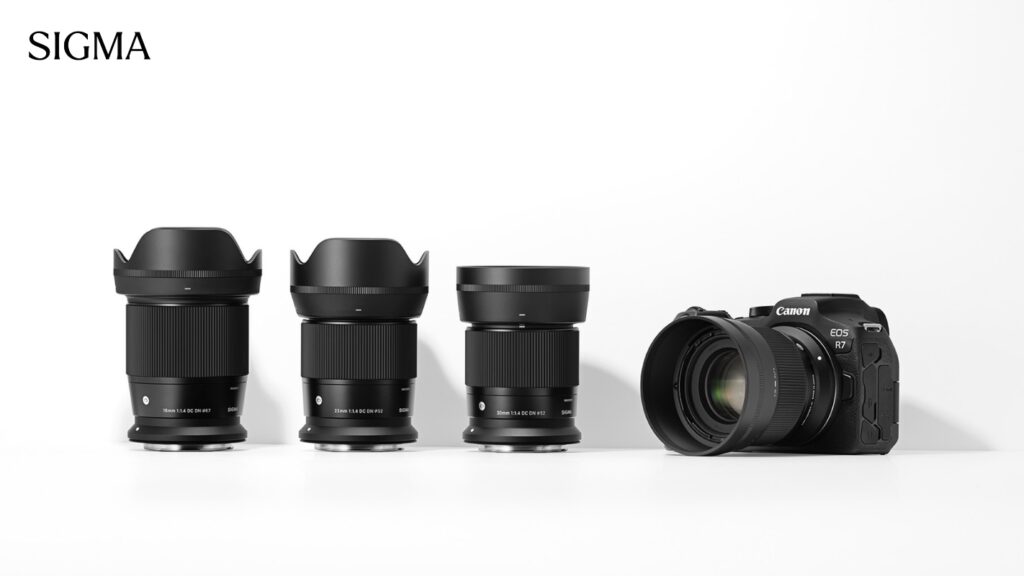
If you’ve recently purchased a Canon R7, R10, or R50 or are planning to, you’re likely wondering which Sigma lenses for Canon RF cameras truly deliver reliable results. It’s the same question most APS-C shooters ask and it’s a fair one.
Lens choices can make or break your results no matter how good your camera body is. Furthermore, with Canon’s RF ecosystem growing fast, knowing your options upfront saves you time, money, and frustration.
This guide covers everything you need: compatibility, real-world performance, and honest lens recommendations for each camera. Let’s get into it.
Are Sigma Lenses Compatible with Canon RF Cameras?
Yes, and more fully than most people expect. Specifically, Sigma lenses for Canon RF cameras work in two ways. First, Sigma now makes lenses with native RF mounts. Second, older Sigma EF lenses work through Canon’s official EF-EOS R adapter. As a result, both options give you autofocus, image stabilization communication, and full EXIF data. The experience is smooth in either case.
One thing to keep in mind: Canon RF is a newer, proprietary mount. Therefore, Sigma had to build dedicated lenses specifically for it. The good news? They’ve done exactly that and the results are impressive, especially for APS-C shooters.
Sigma Lens Compatibility with Canon RF
To begin with, let’s break down the three compatibility paths you have.
Native RF-Mount Sigma Lenses for APS-C Cameras
Sigma launched its Canon RF mount lenses under the “DN” (Digital Native) line. In particular, these are purpose-built for mirrorless cameras. They’re compact, optically sharp, and priced realistically. The DN lenses are designed with APS-C sensors in mind. Consequently, they’re lighter, smaller, and balanced well on the R7, R10, and R50. No unnecessary bulk. No front-heavy handling issues. Current RF-mount DN options include fast primes and versatile zooms. More on those in the lens recommendations section below.
Using Sigma EF Lenses with Canon RF (Adapter Guide)
Already own Sigma EF glass? Good news you don’t need to sell it. The EF to RF adapter from Canon (model EF-EOS R) lets you mount older EF lenses on any Canon RF camera. Autofocus works. Stabilisation works. You won’t lose critical functionality.
In addition, here are a few practical tips if you go this route:
- Always use Canon’s official adapter, not third-party versions
- Update your camera firmware before mounting older lenses
- Expect autofocus to be slightly slower than native RF glass
- The adapter adds some length to the lens, not a dealbreaker, but worth knowing
Overall, for occasional use or budget-conscious shooters, adapting existing EF lenses is a smart move.
Firmware, IBIS and Camera Compatibility
Canon R7, R10, and R50 each handle in-body image stabilization (IBIS) slightly differently. Notably, the R7 has a 5-axis IBIS. It communicates with supported lenses for coordinated stabilization. Sigma DN lenses pass optical stabilization data properly; the R7 uses this intelligently. On the other hand, the R10 and R50 don’t have IBIS. So, stabilization depends entirely on the lens. This makes it more important to choose lenses with optical stabilization (OS) if you shoot handheld video or in low light.
Additionally, always check Sigma’s official firmware update page before shooting. Keeping both your camera and lens firmware current ensures the best autofocus performance and compatibility.
Sigma RF-Mount Lenses for Canon Cameras
Here are the best options for each body based on real shooting scenarios, not just specs.
Best Sigma Lenses for Canon EOS R7
The R7 is Canon’s top APS-C mirrorless body. It has 32.5MP resolution, fast burst shooting, and weather sealing. Naturally, it attracts wildlife photographers, bird shooters, and sports enthusiasts.
- Sigma 18-50mm f/2.8 DC DN (RF): This is arguably the best all-rounder for the R7. The f/2.8 aperture throughout the zoom lens range gives you excellent low-light capability. At 18mm, you get wide environmental shots. At 50mm (80mm equivalent), portraits look beautiful. It’s compact, sharp, and fast to focus. In short, if you’re doing street photography, travel, or event coverage this lens covers most situations.
- Sigma 56mm f/1.4 DC DN (RF): This is the Sigma RF prime lens to get if portraits are your thing. At f/1.4, the bokeh is smooth and professional. The 56mm focal length gives you an 89.6mm full-frame equivalent perfect for headshots and close-up work. Above all, on the R7’s high-resolution sensor, sharpness is stunning.
- Sigma 16-300mm f/3.5-6.7 DC OS: For wildlife and sports, this telephoto lens is a serious option. Yes, it’s larger. But paired with the R7’s crop factor, you effectively get 480mm of reach at the long end. That’s impressive for the price. The built-in optical stabilization (OS) keeps handheld shots stable. Autofocus tracks moving subjects well across the full zoom range.
Best Sigma Lenses for Canon EOS R10
The R10 is a brilliant entry-to-mid level camera. It’s lightweight, shoots 4K video, and is especially popular among content creators and travel photographers.
- Sigma 18-50mm f/2.8 DC DN: Same recommendation as the R7 for good reason. It keeps the R10’s compact profile intact. Moreover, the f/2.8 constant aperture helps massively when shooting indoors or in the evening. With this lens you get image quality that feels far more expensive than it actually is.
- Sigma 16mm f/1.4 DC DN: The standard lens for wide-angle lovers. At 16mm on APS-C, you get a 25.6mm full-frame equivalent. This focal length is ideal for architecture, travel vlogs, and environmental portraits. It’s also very affordable and one of the best value lenses in the Sigma DN lineup. For R10 users who also shoot video, the smooth autofocus and near-silent operation make this a go-to.
Best Sigma Lenses for Canon EOS R50
The R50 is aimed squarely at creators, beginners, and casual shooters. It’s small, friendly, and undoubtedly, produces outstanding image quality for its size.
- Sigma 56mm f/1.4 DC DN: This is our top pick for the R50. The portrait quality you get from this lens at f/1.4 feels genuinely premium. Background separation is dramatic. For instance, for content creators doing product photography, headshots, or YouTube thumbnails results are immediately noticeable.
- Sigma 18-50mm f/2.8 DC DN: The flexibility of a zoom lens with a fast aperture makes this ideal for R50 users who want one versatile lens. It won’t overwhelm the small camera body either. A genuinely practical everyday option.
Top Sigma RF Mount Lenses for Canon Cameras – Complete Quick Guide
| Sigma Lens | Canon Camera Bodies | Best Use Case |
| 18-50mm f/2.8 DC DN | EOS R7, EOS R10, EOS R50 | All-purpose: travel, street, events, everyday use |
| 56mm f/1.4 DC DN | EOS R7, EOS R50 | Portraits, headshots, product shots, strong bokeh |
| 16-300mm f/3.5-6.7 DC OS | EOS R7 | Wildlife, sports, long-range shooting |
| 16mm f/1.4 DC DN | EOS R10 | Vlogging, architecture, wide-angle content |
For Pakistani photographers and creators looking for the best lenses for Canon RF cameras, Sigma’s DN range hits a sweet spot of price, quality, and compactness. You can therefore explore the full availability of these lenses through Sigma Pakistan, the official source for genuine Sigma gear in the country.
APS-C vs Full Frame Lenses for Canon RF Cameras
This causes more confusion than it should. Here’s the simple version.
- APS-C lenses (marked “DC” in Sigma’s lineup) are designed for smaller sensors. However, they’re lighter, more compact, and optically optimised for cameras like the R7, R10, and R50. On an APS-C camera, they behave perfectly.
- Full frame lenses (marked “DG”) can physically mount on APS-C cameras. But they’re larger, heavier, and often more expensive. DG lenses work on crop sensors but are optimized for full-frame. You get sharpness, but not the full benefit you’re paying for.
Generally, for most R7, R10, and R50 users APS-C-specific Sigma Contemporary Canon RF lenses are the smarter buy. They’re optimized for your sensor, and the size/weight difference in the field is noticeable.
The exception? If you plan to eventually upgrade to a full-frame Canon RF body (like the R5 or R6), buying full-frame glass now could be a long-term investment.
How to Choose the Right Sigma Lens for Canon RF
Not sure where to start? Simply, ask yourself these four questions.
- What do I shoot most?
Portraits → fast prime like the 56mm f/1.4
Travel / everyday → the 18-50mm f/2.8 zoom
Wildlife / sports → the 16-300mm telephoto
Architecture / vlog → the 16mm f/1.4 - Do I shoot video?
For video, prioritize lenses with optical stabilization and smooth, quiet autofocus. Accordingly, Sigma’s DN lenses handle video focus well, especially on the R50 and R10. - What’s my budget?
Sigma’s DN range is genuinely affordable without cutting corners on quality. The 56mm f/1.4 and 16mm f/1.4 are especially good value. - Will I upgrade my camera body later?
If you plan to stay on APS-C go for DC DN lenses. Alternatively, if you’re considering a future full-frame move DG lenses are worth considering now.
Sigma Lens Performance on Canon R7, R10 & R50
Let’s talk about real-world results, not just spec sheets.
- Autofocus: Sigma DN lenses perform well with Canon’s Dual Pixel CMOS AF system. Eye-detection and subject-tracking work reliably. The R7 gets the most out of this, given its advanced AF system. R10 and R50 also track subjects smoothly in most conditions.
- Sharpness: Wide open, Sigma DN lenses are impressively sharp. The 56mm f/1.4 and 18-50mm f/2.8 both resolve fine detail cleanly even on the R7’s demanding 32.5MP sensor.
- Build quality: Sigma uses a dust- and splash-resistant design on most DN lenses. Not full weather sealing, but adequate for most real-world conditions.
- Video quality: Breathing control is good. Focus transitions are smooth. The combination of Sigma Canon RF glass with Canon’s in-camera colour science produces pleasing, filmic footage.
For example, a travel photographer using the 18-50mm f/2.8 on an R10 found the combination light enough for a full day of walking — while still producing images sharp enough for large print output. That balance of portability and quality is where Sigma DN lenses genuinely earn their reputation.
Importantly, for photographers in Pakistan, getting genuine Sigma lenses matters. Counterfeit or grey-market glass can underperform and lacks warranty support. Sigma Pakistan offers authentic products with local after-sales support, something worth considering before you buy.
Final Thoughts
Canon’s APS-C RF cameras the R7, R10, and R50 are genuinely capable machines. Without doubt, the right lens multiplies their potential significantly. Sigma lenses for Canon RF cameras deliver on optical quality, autofocus performance, and value. Whether you’re a portrait shooter, a travel photographer, a wildlife enthusiast, or a content creator there’s a Sigma DN lens built for your use case.
Start with one lens that matches your main subject. Master it. Then expand from there. And when you’re ready to buy, make sure you’re getting the real thing. Explore the official range at Sigma Pakistan, your trusted local source for genuine Sigma glass.
Have a question about which Sigma lens suits your Canon RF camera? Drop it in the comments — we’re happy to help.
Frequently Asked Questions
Does autofocus work perfectly with Sigma lenses on Canon R7?
Autofocus with Sigma lenses on the Canon R7 works very well when using Canon EF-mount Sigma lenses via the EF–RF adapter. Performance is fast and accurate for most photography needs. However, native RF lenses still deliver slightly better optimization, especially for advanced tracking and video autofocus.
What lenses work with Canon RF?
Canon RF cameras support native RF and RF-S lenses built specifically for mirrorless systems. They also accept Canon EF and EF-S lenses via the official EF-EOS R adapter. Third-party brands like Sigma offer dedicated RF-mount lenses that deliver full autofocus and stabilization compatibility.
Do Sigma lenses need an adapter for Canon RF?
Only older Sigma EF lenses need Canon’s EF-EOS R adapter. Newer Sigma DN lenses come in native RF mount with no adapter needed. Native RF lenses offer faster autofocus and better overall performance. Always use Canon’s official adapter for full compatibility with EF glass.
What 3 lenses does every photographer need?
Most photographers rely on three essential lenses for complete creative control. A 24–70mm f/2.8 offers everyday versatility, while a 70–200mm f/2.8 excels in portraits and action shots. Paired with a fast 35mm or 50mm prime for low-light and sharp detail, this setup covers nearly every professional scenario.
Why are Sigma lenses so cheap?
Sigma lenses are typically priced lower than Canon, Nikon, or Sony because they operate as a third-party brand focused on delivering high value. They streamline production, reuse designs across mounts, and reduce brand premiums. While image quality remains excellent, they may focus on optimizing size and weight or use alternative materials to keep costs more accessible.
