
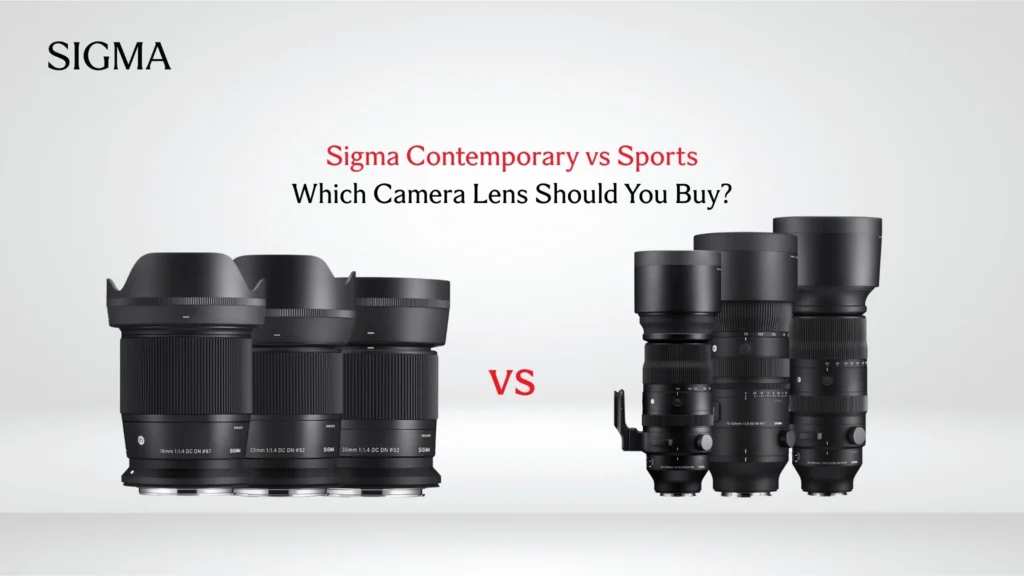
Weight decides which telephoto you actually carry. Sealing decides which one survives a dusty season. Autofocus decides how many frames you keep. Those three factors separate Sigma’s two lines far more than sharpness does. The Sigma Contemporary vs Sports choice is therefore a working-conditions decision, not a quality ranking. Many buyers get this wrong. They order a heavy professional zoom, then leave it at home. Others buy light, then struggle at a floodlit cricket ground. This blog post breaks down each factor against real prices at Sigma Pakistan.
Sigma Contemporary vs Sports: Key Differences at a Glance
Contemporary lenses prioritise compact size, lower weight, and value. Sports lenses prioritise durability, autofocus consistency, and professional handling. Both lines share Sigma’s optical standards, so the image quality gap is narrower than most buyers expect. The real difference sits in build, sealing, and how the lens behaves after four hours of shooting.
| Factor | Contemporary Line | Sports Line |
|---|---|---|
| Design Priority | Portability and value | Durability and reliability |
| Typical Weight | Lighter, handheld friendly | Heavier, monopod friendly |
| Sealing | Mount seal on most models | Full sealing across the barrel |
| Barrel Materials | Composite led | Magnesium alloy on key parts |
| Autofocus | Fast, tuned for general use | Tuned for continuous tracking |
| External Controls | Minimal switches | Custom buttons and torque control |
| Price Band | Mid range | Premium |
Both lines suit different working styles, so the sections below explain who each one serves best.
Contemporary: Compact, Practical, and Value-Focused
A Sigma Contemporary lens delivers strong optics in the smallest practical body. Sigma trims weight by using composite materials and simpler external controls. As a result, you carry less and shoot longer without fatigue.
This line works well when your shooting day involves walking, travel, or long waits. For example, the 100-400mm F5-6.3 DG DN OS Contemporary weighs about 1,160 grams. That figure matters on a Hunza trail or during a full day at Lahore Zoo.
Contemporary lenses still deliver:
- Sharp centre performance across most of the zoom range
- Reliable optical stabilization on telephoto models
- Smaller filter sizes, which lowers your accessory spend
- Everyday durability, though not full professional sealing
The main trade-off is weather resistance. Most Contemporary models seal the mount only, so heavy rain or dust needs extra care.
Sports: Built for Action and Professional Telephoto Work
A Sigma Sports lens is engineered for repeated professional use in poor conditions. Sigma reinforces the barrel with magnesium alloy and adds weather sealing at every joint, switch, and ring. Therefore these camera lenses survive dust storms, stadium spray, and long assignment cycles.
Sports models also add working controls that fast shooters need:
- AFL buttons placed around the barrel for quick focus lock
- Custom mode switch for saving two autofocus behaviour profiles
- Zoom torque control so the barrel stays where you set it
- Tripod collar built to Arca-Swiss compatible standards on recent models
These features cost weight and money. Still, they remove the small failures that ruin paid work.
Sigma 150-600mm Contemporary vs Sports: A Closer Look at One Real Example
The Sigma 150-600 Contemporary vs Sports comparison is the most searched version of this question. Both camera lenses existed side by side in the DSLR era as DG OS HSM models. In the current mirrorless generation, however, Sigma built only the Sports version. Sigma Pakistan therefore stocks the 150-600mm F5-6.3 DG DN OS Sports. Buyers wanting a Contemporary telephoto should look at the 100-400mm F5-6.3 DG DN OS instead.
Weight, Handheld Shooting, and Full-Day Practicality
Weight is the biggest practical difference between these designs. The DSLR-era gap ran close to one kilogram, which changed how photographers worked. Lighter lenses allow handheld panning for longer periods. Heavier lenses reward a monopod and a planned shooting position.
The current 150-600mm DG DN OS Sports narrows that gap sharply. Sigma redesigned it for mirrorless bodies, so it delivers Sports build near Contemporary weight. The old weight penalty argument therefore no longer holds.
Location still decides how much this matters. Weight is a minor issue from a fixed hide or a press box. It becomes the deciding factor on a Margalla Hills trail or a long day in Deosai.
Autofocus Tracking for Wildlife, Birds, and Sports
Sports lenses track erratic subjects more reliably than Contemporary models. Sigma fits stronger motors and tighter drive tuning across the line. The current 150-600mm DG DN OS Sports uses a high response linear actuator.
The difference shows in your keeper rate. Birds launching from water and bowlers in delivery stride demand instant refocusing. Contemporary telephotos handle steady subjects well, but they hesitate more when a subject reverses direction.
Your camera body matters too. Modern mirrorless bodies with subject detection lift results on either lens. Older DSLR bodies gain far more from the stronger Sports drive.
Is the Extra Cost of the Sports Version Worth It?
The Sports premium pays off when failed shots cost you income. Sports stringers, event photographers, and wildlife guides recover it within a few assignments.
Weekend shooting rarely justifies it. Garden birds and school matches never stress a lens that hard, so a faster body or better tripod head serves you more.
Weigh these four factors before committing:
- Shooting frequency: Weekly paid work favours Sports.
- Conditions: Dust, rain, and coastal air favour Sports.
- Transport: Long walks and flights favour Contemporary.
- Resale: Sports telephotos tend to hold value in the local used market.
Which Sigma Lens Line Should You Choose?
Your subject and your working conditions decide the answer, not the badge on the barrel. The four profiles below cover the most common buyers walking into the Sigma Pakistan display at Japan Street, Nisbat Road, Lahore.
Wildlife Photographers
Wildlife shooters usually need reach first and speed second. A wildlife photography lens should reach a 400mm minimum for birds and small mammals. Contemporary telephotos suit photographers who trek to their locations. Sports telephotos suit photographers who work from hides, boats, or vehicles.
Dust is the deciding factor across much of Pakistan. Shooting in Cholistan or the Salt Range pushes any lens hard, so sealing earns its cost quickly there.
Sports Photographers
Working sports shooters should choose Sports every time. A sports photography lens must lock focus instantly and survive touchline conditions. Floodlit cricket, hockey, and football all involve mixed light and constant subject movement.
The 70-200mm F2.8 DG DN OS Sports covers indoor and stadium work. The 150-600mm Sports covers boundary rope distances at larger grounds.
Travel Photographers
Travel photographers get more value from Contemporary lenses. Airline baggage limits and long walking days reward smaller kits. A 100-400mm Contemporary handles mountain compression, street details, and distant wildlife on one trip.
Since travel shooting rarely involves paid deadlines, the Sports advantages matter less here.
Professional Sports Filmmakers
Filmmakers benefit from Sports lenses for mechanical reasons. Zoom torque control keeps framing stable during a shot. Smooth focus transitions and consistent barrel behaviour also help operators track action cleanly.
In addition, heavier barrels dampen small movements on gimbals and shoulder rigs.
Where Do Sigma Art Lenses Fit Into This Decision?
Art lenses sit outside the durability conversation entirely. The Sigma Art vs Contemporary vs Sports structure separates lenses by purpose, not by quality ranking. Art targets maximum optical performance, usually through fast apertures and prime designs.
Choose Art for portraits, weddings, commercial work, and low light. Contemporary for travel and everyday flexibility. Sports for action, reach, and hostile conditions. Many working photographers in Karachi and Islamabad carry all three. An Art prime handles portraits, a Contemporary zoom handles travel, and a Sports telephoto handles assignments.
Sigma DG DN vs DG HSM: Why Lens Generation Matters More Than the Line Name
Generation often matters more than the line badge on modern bodies. The DG DN vs DG HSM distinction tells you which camera system a lens was designed for. DG DN lenses are built for mirrorless mounts. DG HSM lenses were built for DSLR mounts and use a hypersonic motor.
The difference affects real performance:
- Optical design: DG DN lenses exploit shorter flange distances for better corner sharpness.
- Autofocus: Linear motors in DG DN lenses suit mirrorless focus systems better.
- Size: DG DN designs often trim length and weight at the same focal range.
- Compatibility: DG HSM lenses need an adapter on mirrorless bodies.
Because of this, a current Contemporary DG DN lens can outperform an older Sports DG HSM lens on a mirrorless camera. Always check the generation before comparing two lenses by line alone.
Can You Customize a Sigma Contemporary or Sports Lens?
Yes, though Sports lenses offer far deeper customization. Sports models include AFL buttons and a custom mode switch on the barrel. You assign focus behaviour, limiter ranges, and stabilization modes to those positions.
Older DG HSM lenses used the Sigma USB Dock with Sigma Optimization Pro. That software adjusted focus calibration and firmware. Current DG DN lenses update firmware through the camera body or through the USB Dock UD-11, depending on mount.
Sigma Pakistan also offers a mount conversion service for eligible lenses. So switching camera systems does not always mean selling your glass.
Sigma Contemporary vs Sports Price in Pakistan
Contemporary telephotos start well below Sports telephotos in Pakistan. Buyers researching Sigma Sports lens price Pakistan figures should always confirm against live product pages, since import duty and exchange rates move prices.
| Lens | Line | Price (PKR) |
|---|---|---|
| 100-400mm F5-6.3 DG DN OS | Contemporary | 263,000 |
| 28-70mm F2.8 DG DN | Contemporary | 245,000 |
| 150-600mm F5-6.3 DG DN OS | Sports | 415,000 |
| 70-200mm F2.8 DG DN OS | Sports | 424,000 |
| 60-600mm F4.5-6.3 DG DN OS | Sports | 605,000 |
Prices reflect Sigma Pakistan listings at the time of writing. Dollar rate movement can shift these figures, so verify before purchase.
Warranty and Official Versus Grey-Market Considerations
Official stock carries valid Sigma warranty support inside Pakistan. Grey-market imports usually do not. That gap becomes expensive when a stabilization unit or focus motor fails.
Buying through official channels gives you three practical protections:
- Local warranty claims without shipping the lens abroad
- Verified mount version matching your camera system
- Service access through the Hope Enterprises display centre in Lahore
Browse the current lineup by line on the Contemporary and Sports category pages. You can also register your warranty after purchase.
Which Should You Buy: Sigma Contemporary or Sports?
Choose Contemporary when portability and budget lead your decision. Choose Sports when reliability and tracking accuracy lead it. The Sigma Contemporary vs Sports answer changes with your subject, not with your skill level.
A simple test helps. Picture your hardest shooting day this year. If that day involves walking, heat, and long distances, buy Contemporary. If it involves rain, dust, deadlines, or fast subjects, buy Sports.
Final Thoughts
Both Sigma lines deliver serious optical quality, so neither choice is a mistake. The right pick simply matches your working conditions and your budget. Check the generation, confirm the mount, and handle the lens before buying if possible.
Visit the Sigma Pakistan display at Japan Street, Nisbat Road, Camera Market, Lahore to compare both lines directly. The team can also arrange an equipment check through the service centre.
Frequently Asked Questions
Is Sigma Contemporary as sharp as Sports?
Yes, in most shooting situations. Contemporary lenses match Sports optics closely at centre frame. Sports models hold slightly better edge sharpness wide open, though the gap rarely shows in normal prints.
Is a Sigma Sports lens worth the extra money?
Yes, worth it if you need professional durability. Sports lenses trade light weight for metal build, full weather sealing, and stronger long-end optics. Casual shooters get better value from the lighter Contemporary line.
What is the weight difference between Sigma 150-600 Contemporary and Sports?
Around 930 grams. The DSLR-era Contemporary weighs about 1,930 grams and the Sports about 2,860 grams. Sigma’s current mirrorless Sports version is much lighter, at roughly 2,100 grams.
Does Sigma Contemporary have weather sealing?
Partially. Most Contemporary lenses seal only the mount against dust and splashes. Sports lenses seal every ring, switch, and joint, making them the safer choice for rain, dust, and coastal air.
What do C, A, and S mean on Sigma lenses?
C means Contemporary, built for compact size and value. A means Art, built for maximum optical quality. S means Sports, built for durability and fast autofocus tracking in demanding conditions.
What is the difference between DG DN and DG HSM?
DG DN lenses are designed for mirrorless mounts and use linear autofocus motors. DG HSM lenses were built for DSLR mounts, so mirrorless bodies need an adapter to use them.
