
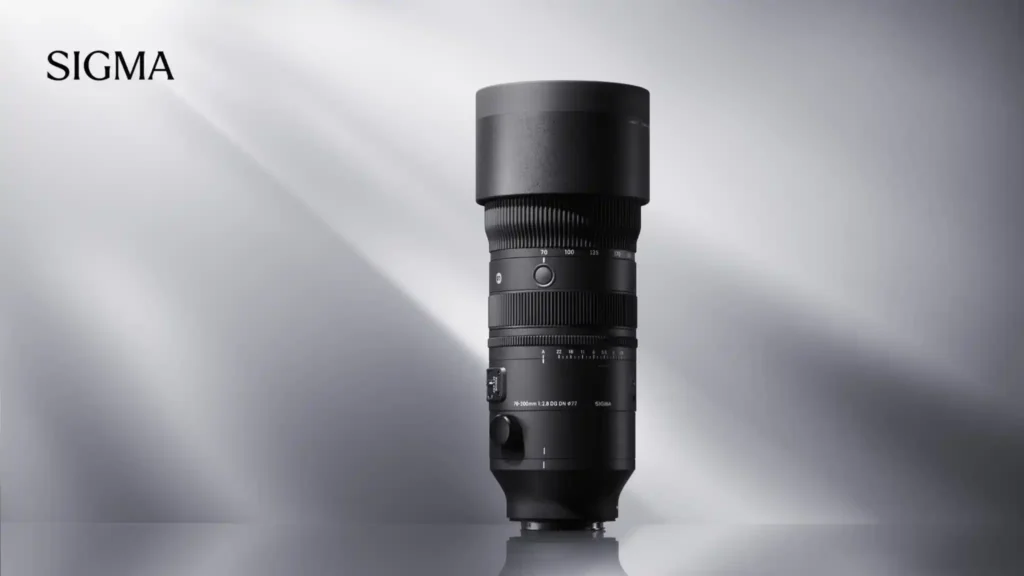
SIGMA lens abbreviations explain a lens’s sensor coverage, camera system and technology in one glance. DG points to full-frame coverage. DC is built for APS-C cameras. DN identifies mirrorless-oriented designs. OS stands for Optical Stabilizer. HSM is Hyper Sonic Motor, and HLA is High-response Linear Actuator. Art, Contemporary and Sports describe three different design philosophies, not a quality ranking. Once these codes make sense, reading any SIGMA lens name becomes simple.
This guide breaks down every abbreviation Pakistani buyers search for, using real examples from the current Sigma Pakistan lineup.
SIGMA lens names tell you important information about the lens. DG means full-frame coverage, DC means APS-C coverage, DN means mirrorless design, OS means Optical Stabilizer, and HLA/HSM describe autofocus motor technology.
How Do You Read a SIGMA Lens Name?
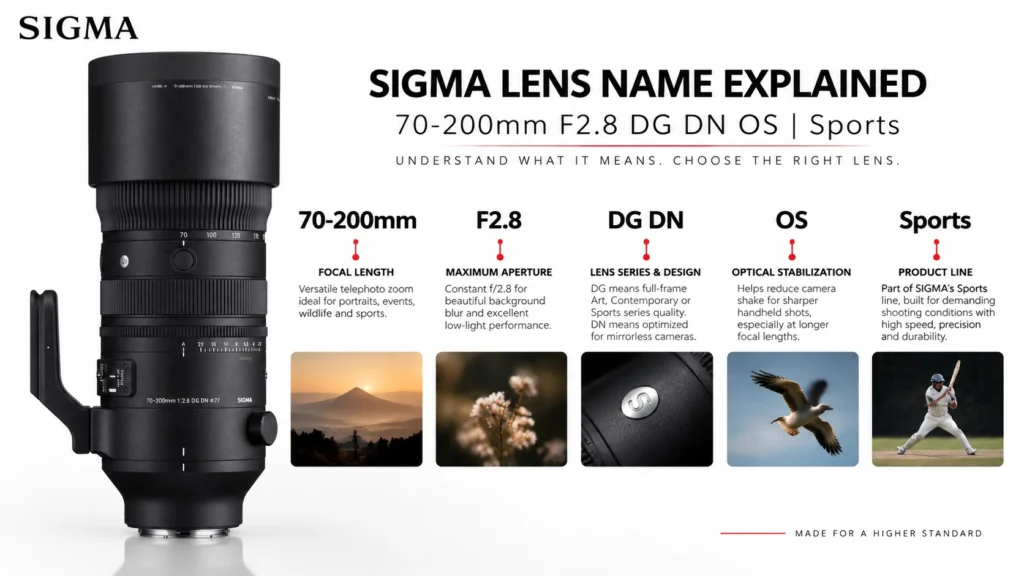
A SIGMA lens name reads left to right, from focal length to design line. Take the SIGMA 70-200mm F2.8 DG DN OS | Sports as an example.
- 70-200mm — the focal length range, or zoom span
- F2.8 — the maximum aperture, constant through the zoom
- DG — full-frame sensor coverage
- DN — a mirrorless-specific optical design
- OS — a built-in Optical Stabilizer
- Sports — SIGMA’s action and telephoto product line
A shorter name follows the same pattern. The SIGMA 10-18mm F2.8 DC DN | Contemporary reads as a compact APS-C mirrorless lens built for wide-angle work. Once this order clicks, every SIGMA name becomes easy to decode.
Some names also carry a Roman numeral, like the 35mm F1.4 DG II | Art. This marks a second-generation version of an existing lens, redesigned with updated optics or autofocus. No numeral simply means the lens is on its first generation.
What Do DG and DC Mean on SIGMA Lenses?
DC and DG describe sensor coverage on a SIGMA lens. DG lenses cover a full-frame sensor, while DC lenses are built specifically for APS-C cameras.
DG — Full-Frame Coverage
SIGMA DG meaning points to an image circle large enough for a full-frame sensor. DG lenses project light edge to edge on a 35mm-sized sensor. Many SIGMA Art and Sports lenses carry this code, including the 24-70mm F2.8 DG DN II Art available on Sigma Pakistan.
DC — APS-C Coverage
SIGMA DC meaning refers to a smaller image circle sized for APS-C sensors. DC lenses are generally lighter and more compact than their DG counterparts. The Nikon Z-mount 16mm, 30mm and 56mm F1.4 DC DN primes are good examples of this design.
DG lenses work perfectly on APS-C cameras within the same mount system. The sensor simply uses the center of the image circle, which increases the effective focal length by the camera’s crop factor. SIGMA DG vs DC really comes down to sensor size, not build quality. DC lenses, however, are not designed for full-frame sensors. Mounting a DC lens on a full-frame body usually triggers a crop mode or produces heavy vignetting. A 1.5x crop APS-C sensor turns an 18mm DC lens into an effective 27mm field of view.
What Does DN Mean on a SIGMA Lens?
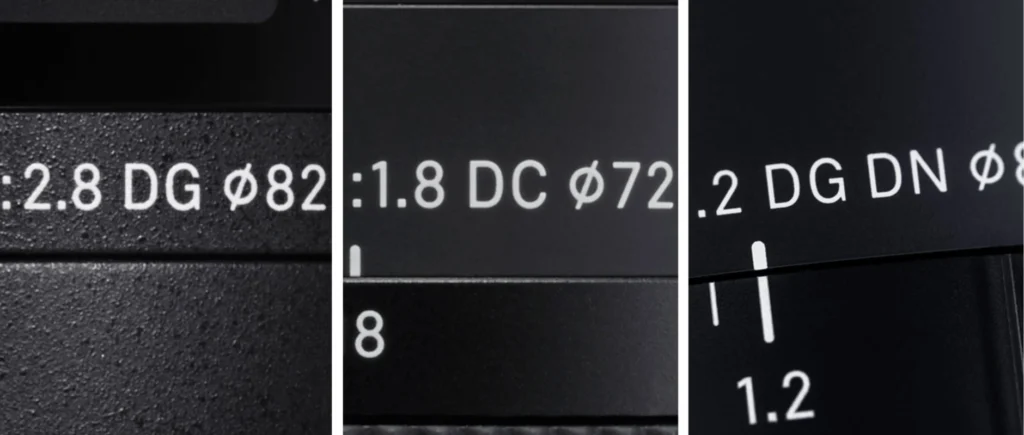
DN in a SIGMA lens meaning points to mirrorless design, not sensor size. DN does not mean APS-C on its own. SIGMA always pairs DN with either DG or DC to show both mount type and sensor coverage together:
- DG DN = full-frame mirrorless
- DC DN = APS-C mirrorless
Both share the same DN optical architecture, built for the shorter flange distance found on mirrorless cameras.
DG DN vs DC DN: What Is the Difference?
SIGMA DG DN vs DC DN comes down to one thing: sensor coverage. DG DN means the lens is built for full-frame mirrorless cameras. DC DN means the lens is built for APS-C mirrorless cameras. The table below breaks down the practical difference.
| DG DN | DC DN |
|---|---|
| Full-frame coverage | APS-C coverage |
| Mirrorless design | Mirrorless design |
| Usually larger size | More compact design |
| For full-frame systems | For APS-C systems |
SIGMA DG DN vs DC DN matters most when choosing glass for an APS-C mirrorless camera. An APS-C photographer should generally pick a DC DN lens first. These lenses are lighter, smaller and priced for APS-C budgets. A DG DN lens will still mount and work on an APS-C body of the same system. However, the photographer carries extra size and weight without gaining any sensor coverage benefit. Full-frame users should stick to DG DN lenses, since DC DN options crop or vignette on a full-frame sensor. The right choice depends on the camera body already owned, not personal preference alone.
What Does OS Mean on a SIGMA Lens?
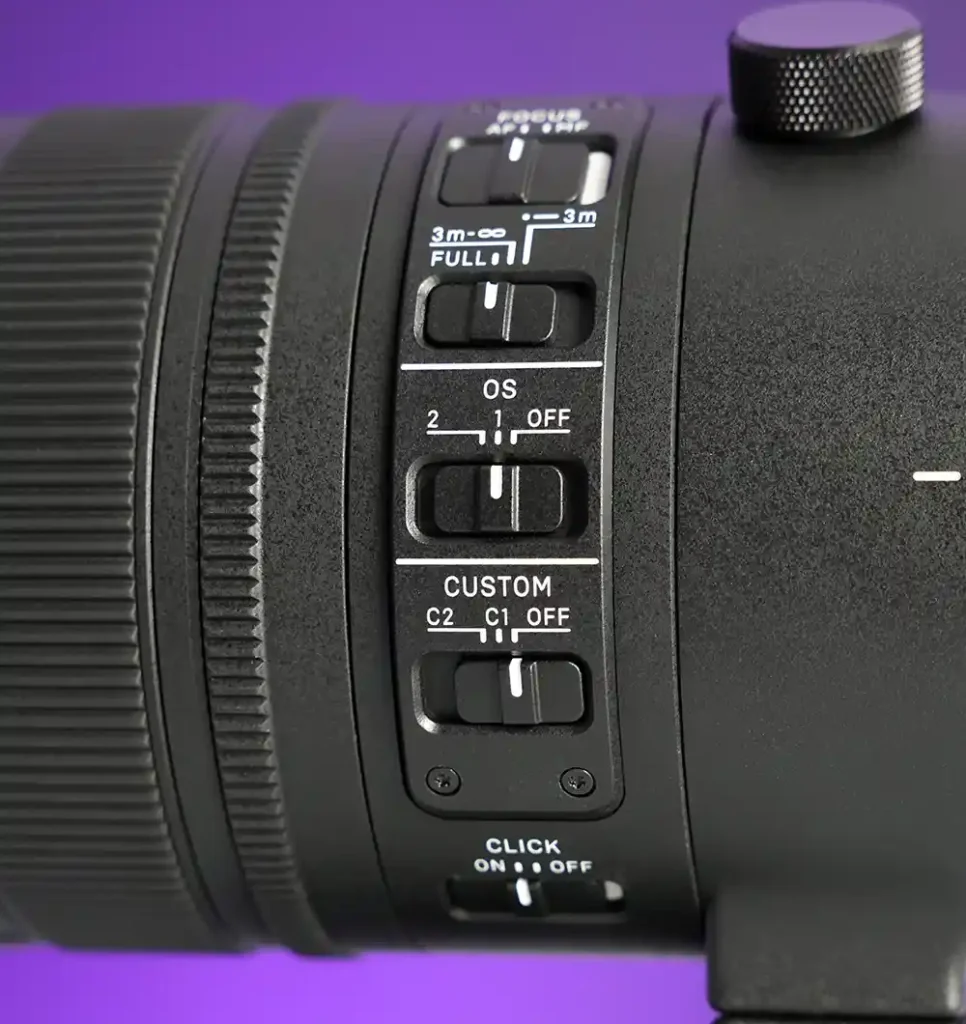
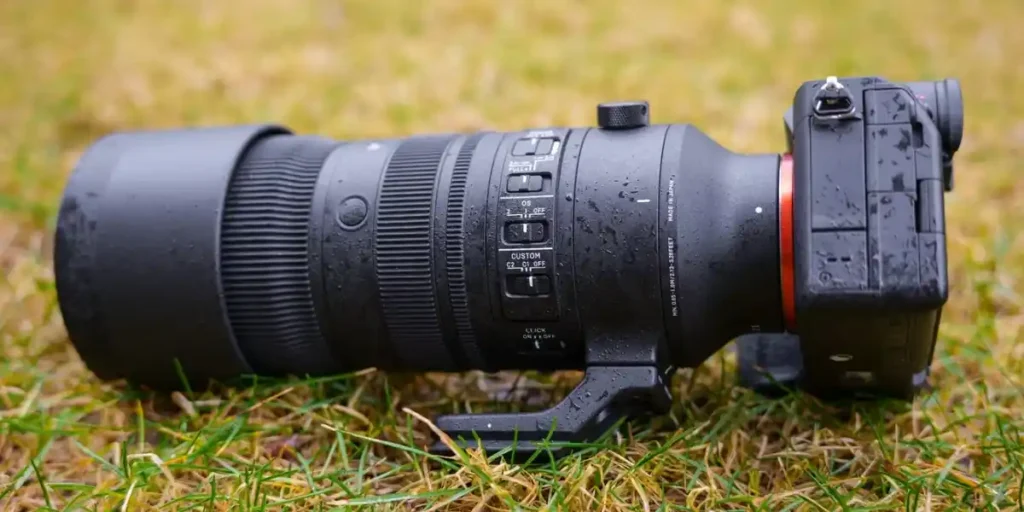
SIGMA OS means Optical Stabilizer. OS shifts a floating lens element inside the barrel to counter small hand movements during a shot. This keeps images sharp at slower shutter speeds, especially on telephoto lenses. Sigma Pakistan currently stocks several OS lenses, including the 150-600mm F5-6.3 DG DN OS | Sports and the 70-200mm F2.8 DG DN OS | Sports, both built for wildlife and action work
Do You Need OS If Your Camera Has IBIS?
OS and in-body stabilization solve overlapping but different problems. IBIS compensates for camera shake across most focal lengths on the body itself. The OS is tuned specifically to the lens it sits inside, which helps most at longer telephoto ranges. Many photographers keep the OS switched on even with IBIS active, since the two systems can work together on newer mirrorless bodies. A lens without OS still benefits from a camera’s IBIS, so its absence is not a dealbreaker on standard prime lenses.
HSM vs HLA: What Do SIGMA Autofocus Motor Names Mean?
SIGMA HSM vs HLA comes down to two different autofocus motor technologies. Both drive the lens elements that bring a subject into sharp focus.
HSM — Hyper Sonic Motor
SIGMA HSM meaning is Hyper Sonic Motor, an ultrasonic-type focus motor. HSM has powered SIGMA autofocus lenses for years across DSLR-mount and earlier mirrorless designs. It delivers fast, quiet focusing suited to everyday and action shooting alike.
| HSM | HLA |
|---|---|
| Ultrasonic motor | Linear actuator motor |
| Common on earlier lens designs | Common on newer mirrorless Art lenses |
| Fast and quiet autofocus | Fast, quiet and highly responsive autofocus |
HLA — High-response Linear Actuator
SIGMA HLA meaning is High-response Linear Actuator, a newer motor built for mirrorless systems. HLA moves the focus group in a straight line instead of rotating it. This produces quicker, more precise focus tracking, useful for video and fast-moving subjects.
What Do Art, Contemporary and Sports Mean?
Art, Contemporary and Sports are SIGMA’s three lens lines, each built around a different design goal. None of them is a quality tier above the others.
Art
The Art line targets outstanding optical performance and creative control. These lenses suit portrait, landscape and architectural photographers chasing maximum sharpness. Many Art primes carry wide maximum apertures for shallow depth of field. Lenses like the 35mm F1.4 DG ll Art and 85mm F1.4 DG DN Art fall in this line, popular for detailed architectural shots around Lahore’s Walled City.
Contemporary
The Contemporary line balances strong performance with compact size and lower weight. These lenses fit photographers who travel light or shoot everyday scenes. Contemporary lenses usually cost less than Art or Sports equivalents while holding solid image quality. The 28-70mm F2.8 DG DN | Contemporary is a good example of this balance.
Sports
The Sports line targets fast-moving subjects in demanding conditions. These lenses feature weather sealing, quick autofocus and rugged builds. Wildlife and action photographers rely on this line, including those shooting in remote terrain like Deosai National Park. The 60-600mm F4.5-6.3 DG DN OS | Sports covers extreme telephoto reach for exactly this kind of work.
SIGMA Art vs Contemporary and Sports remain three different design philosophies, not simply good, better and best. A dedicated Art vs Contemporary comparison on the Sigma Pakistan blog covers this choice in more depth.
What Do 18-50mm, 85mm and F1.4 Mean?
Every SIGMA lens name includes two number groups beyond the letter codes. One describes focal length, the other describes aperture. Together, these numbers tell a buyer exactly what the lens sees and how it performs in light.
Focal Length Numbers
Focal length numbers describe how wide or zoomed a lens shoots, measured in millimeters.
- 85mm = prime, a fixed focal length ideal for portraits
- 18-50mm = zoom, useful for general APS-C shooting
- 70-200mm = telephoto zoom, built for distance and sports
F1.4, F2.8 and Other Aperture Numbers
Aperture numbers describe the widest opening a lens can reach.
- Lower f-number = wider maximum aperture
- Wider apertures let in more light, which helps in low-light conditions
- Wider apertures also create a shallower depth of field, blurring the background more
An F1.4 lens gathers noticeably more light than an F2.8 lens at the same settings.
- Camera mount
- Sensor size
- Exact lens version
How Do I Know If a SIGMA Lens Fits My Camera?
SIGMA lens compatibility depends on three quick checks. Running through these steps confirms whether a lens fits and functions correctly on a given camera.
1. Check the Camera Mount
SIGMA lenses come in Sony E, L-Mount, Canon RF, Fujifilm X and Nikon Z options across the current lineup. A lens mount must match the camera mount exactly. An adapter can bridge some combinations, but native mount options give better autofocus performance overall.
2. Check Sensor Size
SIGMA full frame vs APS-C lens choice depends entirely on the camera’s sensor size. A full-frame camera needs a DG or DG DN lens for full coverage. An APS-C camera can use either a DC or DG lens, though DC lenses stay smaller and lighter for that sensor.
3. Check the Exact Lens Version
Every SIGMA lens is built separately for each mount system. A Sony E version and a Canon RF version of the same lens are not interchangeable. Always confirm the exact mount listed on the product page before ordering through Sigma Pakistan or an authorized dealer.
SIGMA Lens Abbreviations Quick Reference
| Code | Meaning |
|---|---|
| DG | Full-frame sensor coverage |
| DC | APS-C sensor coverage |
| DN | Mirrorless-oriented optical design |
| OS | Optical Stabilizer |
| HSM | Hyper Sonic Motor autofocus system |
| HLA | High-response Linear Actuator autofocus system |
| Art | Optical performance and creative-focused lens line |
| Contemporary | Compact design with balanced performance and portability |
| Sports | Action and telephoto-focused lens line built for demanding use |
Keep this table handy the next time a SIGMA lens name looks confusing. Sigma Pakistan’s product pages list the full name for every lens, so matching these codes to a purchase stays quick and reliable.
Frequently Asked Questions
What does DG mean on a SIGMA lens?
DG means the lens covers a full-frame sensor. It projects light edge to edge across a 35mm-sized sensor, delivering complete coverage without cropping or vignetting.
What does DC mean on a SIGMA lens?
DC means the lens is built for APS-C sensors. It has a smaller image circle than DG lenses, making DC lenses more compact and lightweight overall.
What does DN mean on SIGMA lenses?
DN means the lens has a mirrorless-specific design. It doesn’t indicate sensor size alone, so SIGMA always pairs it with DG or DC for full clarity.
What is DG DN vs DC DN?
DG DN covers full-frame mirrorless cameras, while DC DN covers APS-C mirrorless cameras. Both share mirrorless-optimized optics, but differ in sensor coverage and lens size.
What does OS mean?
OS stands for Optical Stabilizer. It shifts a floating lens element to counter hand movement, keeping images sharp at slower shutter speeds, especially on telephoto lenses.
How do I know if a SIGMA lens fits my camera?
Check three things: the camera mount, sensor size, and exact lens version. A Sony E lens will not fit a Canon RF or Nikon Z camera.
