
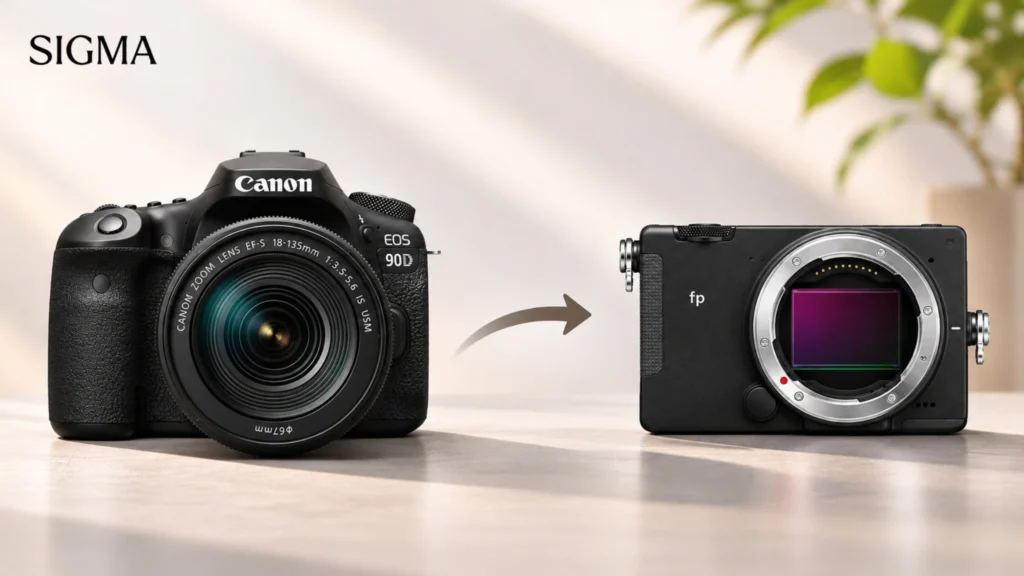
Yes, you can keep most of your lenses when switching from DSLR to mirrorless. The right adapter keeps many of them working, often with full autofocus. Whether yours make the move depends on three things: the lens mount, your new camera brand and who made the lens.
If you’ve spent years building a DSLR kit, selling it at a loss to start over hurts. Below, you’ll see which lenses adapt well, where adapters fall short and when a native lens is the smarter spend.
Should You Switch From DSLR to Mirrorless?
For most working photographers, yes, but only once your lens plan is clear. The camera body is the easy part. The lenses decide what the move really costs.
Good reasons to move from DSLR to mirrorless:
- Eye and subject detection autofocus, which helps at weddings, events and portraits
- An electronic viewfinder that previews exposure before you press the shutter
- Stronger video features on most current bodies
- New lens launches now arrive mainly for mirrorless mounts
Good reasons to wait a little:
- Your DSLR still delivers what clients pay for
- Most of your lenses are old screw-drive or unsupported third-party models
- The budget covers a body but not the adapter or lenses you will need
So the honest answer to should I switch to mirrorless comes from your lens bag. The sections below check each system one by one.
Which DSLR Lenses Can Be Adapted to Mirrorless?
Most modern autofocus DSLR lenses can be adapted. Results range from near-native performance to manual focus only. Not sure which mount your lens or camera uses? Our SIGMA mount and sensor guide explains it.
| Lens → Body | Adapter | Autofocus |
| Canon EF/EF-S → Canon RF | Canon EF-EOS R | Full AF |
| SIGMA EF/SA → Sony E | SIGMA MC-11 | AF, single-shot best |
| SIGMA EF/SA → L-Mount | SIGMA MC-21 | AF-S only |
| Nikon AF-S/AF-P → Nikon Z | Nikon FTZ / FTZ II | Full AF |
| Nikon AF/AF-D → Nikon Z | Nikon FTZ / FTZ II | Manual only |
A useful lens adapter for mirrorless camera bodies has electronic contacts. Cheap metal rings fit the mount, but you lose autofocus, aperture control and lens data.
Canon EF Lenses on Canon RF Bodies
This is the simplest switch of all. Canon’s Mount Adapter EF-EOS R accepts every Canon EF and EF-S lens. Autofocus and lens stabilization keep working.
The adapter has no glass inside it. That means your lens keeps its original optical quality.
Canon sells three versions:
- Mount Adapter EF-EOS R: the plain, lowest-cost option
- Control Ring Mount Adapter EF-EOS R: adds a ring you can set to aperture, ISO or exposure compensation
- Drop-In Filter Mount Adapter EF-EOS R: holds a drop-in ND or polarizing filter, handy for video shooters
EF-S lenses are made for APS-C DSLRs. On an EOS R body, the camera crops the image automatically to match them.
Own SIGMA lenses for Canon EF? SIGMA states that its Art, Contemporary and Sports lenses for Canon EF work with Canon’s adapter. Update each lens through the SIGMA USB Dock first, using our SIGMA lens firmware update guide. One quirk from SIGMA’s own tests: its DC (APS-C) lenses do not switch the camera to crop mode automatically. Turn on the 1.6x crop setting yourself.
If you are shopping for a Canon EF to RF adapter, buy Canon’s own version. Canon supports its own lenses on it. For third-party lenses, the lens maker handles compatibility, so SIGMA’s list is the one to check.
SIGMA Canon EF-Mount Lenses on Sony E-Mount: MC-11
The SIGMA MC-11 lets SIGMA lenses built for Canon EF, or SIGMA’s own SA mount, work on Sony E-mount bodies. Autofocus, auto exposure and in-camera lens corrections all stay active.
Here is what makes it different from a generic adapter:
- It stores control data for each supported lens and tunes AF and aperture to match
- An LED shows whether the attached lens is compatible
- New lens support arrives through firmware updates from a computer
- The inside is flocked to cut internal reflections
There are clear limits too. The MC-11 does not work with teleconverters. When SIGMA launched native E-mount Art primes, it said those lenses support Sony’s continuous AF and high-speed AF. It also said the MC-11 does not cover those modes. For sports, wildlife or fast-moving kids, a native lens will track better.
SIGMA lenses for Nikon F will not fit the MC-11 at all. It comes only in Canon EF and SIGMA SA versions.
Which SIGMA Lenses Work With MC-11?
The MC-11 is built for SIGMA’s DSLR lenses, the ones with HSM in their names. (Our guide to SIGMA lens letters like DG, DC, DN and HSM explains each code.) DSLR lenses are the older technology. SIGMA’s newer lenses are made for mirrorless cameras, and Sigma Pakistan carries this mirrorless range. If you already own an HSM lens, here are supported examples:
- 20mm F1.4 DG HSM Art
- 24mm F1.4 DG HSM Art
- 35mm F1.4 DG HSM Art
- 50mm F1.4 DG HSM Art
- 24-35mm F2 DG HSM Art
- 24-105mm F4 DG OS HSM Art
- 120-300mm F2.8 DG OS HSM Sports
- 150-600mm Sports
- 150-600mm Contemporary
- 18-35mm F1.8 DC HSM Art
- 50-100mm F1.8 DC HSM Art
- 30mm F1.4 DC HSM Art
- 17-70mm Contemporary
Canon-brand lenses are not on SIGMA’s list. Some may work, but SIGMA does not promise it. Before you buy, check the full list on SIGMA’s website and update both lens and adapter firmware.
Can an HSM lens become a mirrorless lens? Partly. SIGMA’s Mount Conversion Service can only move a lens to a mount SIGMA released that exact lens in. Several DG HSM Art primes, such as the 35mm F1.4 and 50mm F1.4, were also sold in Sony E-mount. Those can be converted to a native Sony E fit, with no adapter needed.
The conversion changes the mount, not the lens design. The optics and HSM focus motor stay the same, so it does not become a newer DG DN mirrorless lens. HSM lenses were never released for Canon RF or Nikon Z, so on those bodies an adapter is the only route.
Buying new for a mirrorless body? Sigma Pakistan stocks SIGMA’s DG DN and DC DN lenses, which are designed for mirrorless from the start.
SIGMA EF and SA Lenses on L-Mount: MC-21
The SIGMA MC-21 adapts SIGMA’s EF-mount and SA-mount lenses to L-Mount cameras from Panasonic, Leica and SIGMA. It comes in two models, EF-L and SA-L. Pick the one that matches your lens mount.
What you get:
- Autofocus in AF-S (single-shot) mode, with auto exposure
- Lens type, focal length and aperture saved in each file’s Exif data
- Automatic crop when you mount a DC lens on a full-frame body
- A light build at 145g
The trade-off is focus tracking. Continuous AF (AF-C) is not supported, so this route suits studio, landscape and interview work best. Keep the MC-21 and your camera on their latest firmware.
Nikon F Lenses on Nikon Z With the FTZ Adapter
The Nikon FTZ adapter and the newer FTZ II give full autofocus and auto exposure with 94 types of AF-S, AF-P and AF-I lenses. Nikon says image quality and AF performance match what you got on a DSLR.
Around 360 types of NIKKOR F lenses from the AI series onward work with auto exposure. Not all of them autofocus, though. The big catch is screw-drive lenses. Older AF and AF-D lenses rely on a focus motor inside the DSLR body. Neither FTZ version has that motor, so these lenses become manual focus only.
The FTZ II does the same job as the original. It drops the tripod foot and is slimmer, which suits cameras with a battery grip. SIGMA has stated that its current lenses for Nikon F keep full function on the FTZ. Older SIGMA models may behave differently, so check SIGMA’s notice for your exact lens.
Does a Lens Adapter Affect Autofocus or Image Quality?
Image quality stays the same with a good electronic adapter, because there is no glass inside. Autofocus is where the differences show up.
- Near-native AF: Canon lenses on Canon’s EF-EOS R adapter, and Nikon AF-S or AF-P lenses on the FTZ
- Good for still subjects: SIGMA lenses on the MC-11 or MC-21, where continuous tracking is limited
- No AF at all: Nikon screw-drive lenses on the FTZ, and any lens on a contact-free metal ring
An adapter also adds length and some weight to your kit. On a gimbal, that changes the balance point. Plan for it before a shoot.
What Happens When You Use APS-C Lenses on Full-Frame Mirrorless?
The camera switches to crop mode and uses only the centre of the sensor. You keep a clean image but lose a big share of your megapixels. Our SIGMA DC DN vs DG DN guide explains which lenses are made for which sensor size.
A quick example: a 24MP full-frame body in 1.5x crop gives roughly 10.7MP. At Canon’s 1.6x crop, it drops to about 9.4MP.
How each system handles it:
- Canon: EF-S lenses crop automatically. SIGMA DC lenses on Canon’s adapter need crop mode turned on manually.
- Sony: Set the camera to APS-C or Super 35 mode.
- L-Mount with MC-21: Crop is applied automatically.
- Nikon Z with FTZ: DX lenses shoot at a 1.5x crop.
That resolution is fine for social media, YouTube and Super 35 video. For large prints or heavy cropping, plan to replace APS-C lenses.
Can SIGMA Change Your Lens Mount Instead of Using an Adapter?
Yes, for many lenses. SIGMA runs a paid Mount Conversion Service that replaces your lens mount and the matching internal parts for another camera system.
Key rules of the SIGMA mount conversion service:
- Only lenses from the SIGMA Global Vision lines (Art, Contemporary and Sports) qualify
- A lens can only move to a mount SIGMA already makes that lens in
- It is a paid service, even if your lens is under warranty
- Expect around four to eight weeks, longer if the lens goes to SIGMA’s factory in Aizu, Japan
- Converted lenses get a six-month warranty on the work
- Requests go through your nearest authorized SIGMA distributor
In Pakistan, that means contacting Sigma Pakistan to confirm eligibility, cost and timing for your lens. Conversion makes most sense for expensive lenses you plan to keep for years.
Keep, Adapt or Replace? A Simple Decision Guide
Your current camera still delivers what clients need, and the cost of changing systems is not yet justified.
You can also keep the DSLR as a backup when you eventually upgrade.
- The lens appears on Canon’s, Nikon’s or SIGMA’s compatibility list
- You shoot portraits, products, landscapes, food or interviews
- It is a high-value lens, such as a 120-300mm F2.8 Sports or a fast Art prime
- You want to test a mirrorless body before rebuilding your whole kit
- You need continuous AF for sports, wildlife, weddings or fast events
- Your Nikon lenses are screw-drive AF or AF-D models
- You want a smaller, lighter kit without an adapter in the middle
- Your APS-C lenses would leave a full-frame body in crop mode
- The lens is missing from every compatibility list
Best First SIGMA Lens After Switching to Mirrorless
The right first lens depends on your new mount. For most full-frame shooters on Sony E or L-Mount, a fast standard zoom is the safest first buy.
Covers weddings, events and travel in one lens.
The first full-frame F1.8 zoom for mirrorless.
Released April 2026. Suits street, reportage and environmental portraits.
18-50mm F2.8 DC DN , 10-18mm F2.8 DC DN and 17-40mm F1.8 DC Art.
More in our best SIGMA RF-mount lenses for Canon R7, R10 and R50 .
On a full-frame Canon EOS R body, SIGMA’s RF line so far is APS-C only. Here, adapting your SIGMA EF Art lenses is still the smart route.
Browse current stock and PKR prices in the SIGMA Pakistan lens collection. Every lens bought there comes through the official SIGMA distributor in Pakistan.
What to Do With Your Old DSLR Kit in Pakistan
Don’t sell everything at once. Test each lens on your new body with the right adapter first, then decide.
Practical options:
- Keep the DSLR as a backup. A second body at a wedding or mehndi can save the day.
- Sell unsupported lenses. Screw-drive Nikon lenses and old third-party glass are worth more to a DSLR buyer than to you.
- Convert high-value SIGMA lenses. Ask about mount conversion before selling an Art or Sports lens at a loss.
- Prepare items for sale. Check for fungus and haze, which humid monsoon months can cause. Our guide to camera lens fungus in Pakistan shows how to spot it. Note your DSLR’s shutter count too, since buyers will ask. Include caps, hood and the original box.
Not sure which route fits your kit? Contact Sigma Pakistan on Nisbat Road, Lahore, with your lens names and new camera model.
Frequently Asked Questions
Can I use Canon EF lenses on a Sony mirrorless camera?
Yes, Canon EF-mount lenses fit Sony mirrorless cameras through the SIGMA MC-11 adapter. Full support covers SIGMA’s own EF lenses on its compatibility list, with autofocus and auto exposure. Canon-brand EF lenses may work, but SIGMA does not guarantee them.
Do lens adapters reduce image quality?
No, a lens adapter for mirrorless cameras does not reduce image quality when it has no glass inside. Canon’s EF-EOS R, the Nikon FTZ, the SIGMA MC-11 and the MC-21 are all glassless. Autofocus speed and tracking can still change, depending on the lens and adapter.
Does the SIGMA MC-11 work with every Canon EF lens?
No, the SIGMA MC-11 does not work with every Canon EF lens. It is built for SIGMA’s Art, Contemporary and Sports lenses listed on SIGMA’s compatibility chart. It also does not support teleconverters or SIGMA lenses made for Nikon F.
Is it worth switching from DSLR to mirrorless?
Yes, switching from DSLR to mirrorless is worth it for most active photographers and videographers. You gain eye-detection autofocus, an electronic viewfinder and stronger video tools. Check your lenses first, since adapter support decides the real cost of the move.
Can I use Nikon DSLR lenses on Nikon Z cameras?
Yes, Nikon DSLR lenses work on Nikon Z cameras with the Nikon FTZ or FTZ II adapter. AF-S, AF-P and AF-I lenses keep full autofocus and auto exposure. Older AF and AF-D screw-drive lenses work in manual focus only, because the adapter has no focus motor.
